(My) Second Year of the Linux Desktop (For Gaming)
As much as we joke about the phrase, I don't think there will ever be a true Year of the Linux Desktop. However, I want to advocate that people should talk about their Year of the Linux Desktop, and I want to leave what exactly the requirements are for that up to the individual. You will know when its the time. For me, this is my Second Year of the Linux Desktop and I want to share why I think so.
I have some history of using Linux on desktop
In my post on being a laptop weirdo I covered my personal history of using Linux on laptops since 2008 and the terrible terrible things I did to those laptops. However, my history with Linux on the desktop goes back even earlier than that.
I am really fortunate I had access to computers and dial-up at a young age because my dad needed them for billing insurance from his office. Insurance also forced him to upgrade his computer pretty regularly, which gave me a stream of old computers to dismember and reassemble. At some point I ended up with an old PC in my bedroom, but I had no internet of course.
I think the very first distribution of Linux I installed was Puppy Linux. That's because Puppy was tiny so I could download the ISO in a reasonable amount of time and burn it onto a CD. This was probably circa 2003 when it first released, and I did very little aside from try it out. I did realize though, that I was only using Windows at the time since it felt like the only option. I've never had an affinity towards Windows.
In 2005 I did a Spanish class video project. My room was on an upper floor and extremely hot. I remember sitting up there with my friends trying to edit the footage in Windows Movie Maker and get the project finished. Around that time I received in the mail a CD of Ubuntu 5.10 and installed onto a second drive I had put into my computer. I made the classic mistake of not checking my drives and accidentally wiped the Windows drive, destroying the video project in the process. We had to refilm and edit everything all over again. Despite all odds, I am still friends with that project-mate and I still like Linux.
Around 2008, I shifted to mostly using Linux on my laptop, as I describe in the linked post. However, up until I went to college in 2011 I also ran Linux in VirtualBox on Windows. In my post fond memories of a high school personal project you can see some scans of printouts of screenshots of the Ubuntu VM.
In college I triple booted Windows, Arch Linux and OS X on my MBP and mostly went without a desktop. Post-college I dual booted Windows and Linux on my desktop. I primarily used the Linux installation for personal projects because investment banks forced my work to do our development on Windows and I was sick of that.
This takes us up to around 2019 when I started playing with Ansible on various hardware I owned, which eventually led to me moving from Arch to NixOS. I haven't done a full post on NixOS, but I have talked about setting up my Framework Laptop 13 with NixOS. Anyways, one nice thing about NixOS is you have a full history of your system configuration over the years, which is excellent if you are feeling nostalgic. In 2020 I checked in my first commit for a NixOS config.
Also around that time, the pandemic hit and I started to work from home, I had to run Citrix to connect to a remote machine for work. I spent a long time trying to get that to work on Linux but never succeeded. This was as clear a sign as any that I wanted out from Windows.
A Steam Replay Comparison
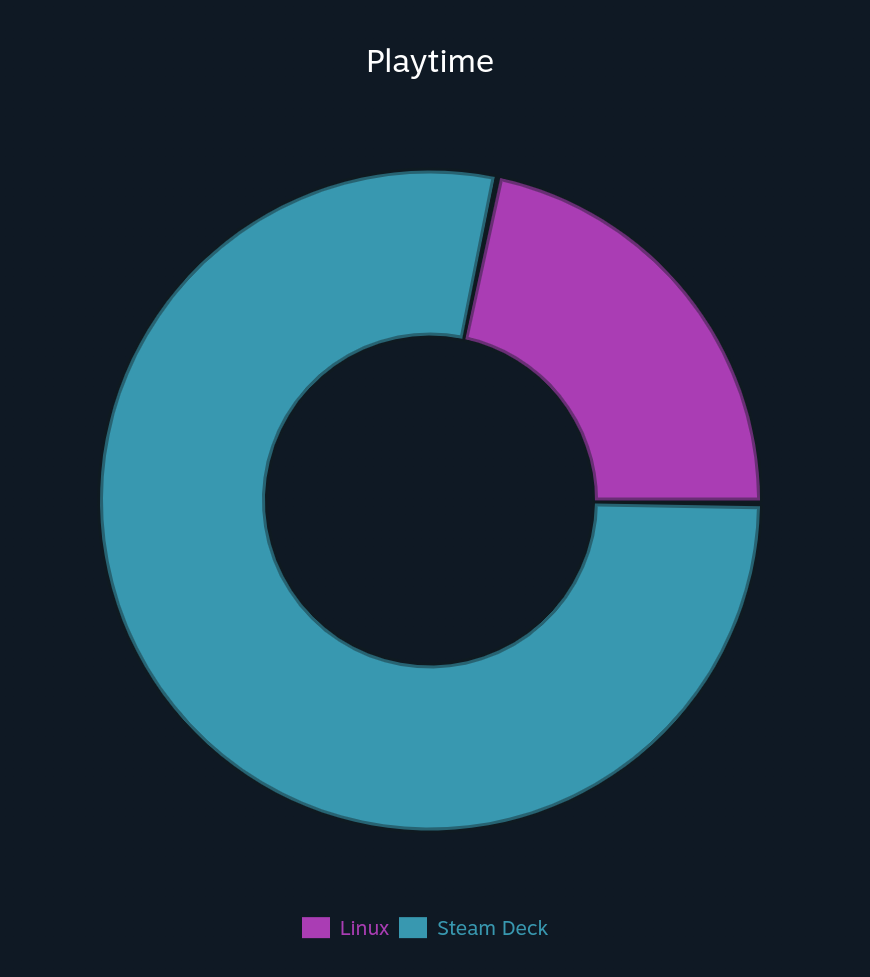
A couple years ago steam started doing replays like everyone else out there. The interesting thing is they included a pie chart showing time spent playing games on each OS.
Note: the color coding for the OS playtime pie chart is not consistent across years.
Also note, from the FAQ:
No, Steam Replay does not include any playtime played in offline mode or when disconnected from internet.
I had several flights and road trips over the years where I got in a lot of Steam Deck time that wasn't captured.
2021 - Another year of the windows desktop
There is no steam replay for 2021. If there was, it would show a majority of my time playing games on Windows and a small sliver playing on Linux desktop. That's because in December of 2021 I see a commit on my NixOS config adding Steam.
Also, I tried, and failed to buy a Steam Deck at launch in 2021. I got caught in the payment processing crunch.
FFXIV came to steam in 2014, a year after the A Realm Reborn relaunch. If you bought XIV on Steam you would eventually get easy native proton setup.[1] However, if you bought the game outside of Steam you couldn't log into the Steam Version. Running the game outside of Steam was finicky so I continued to play on Windows.
2022 - A year of some amount of Linux desktop
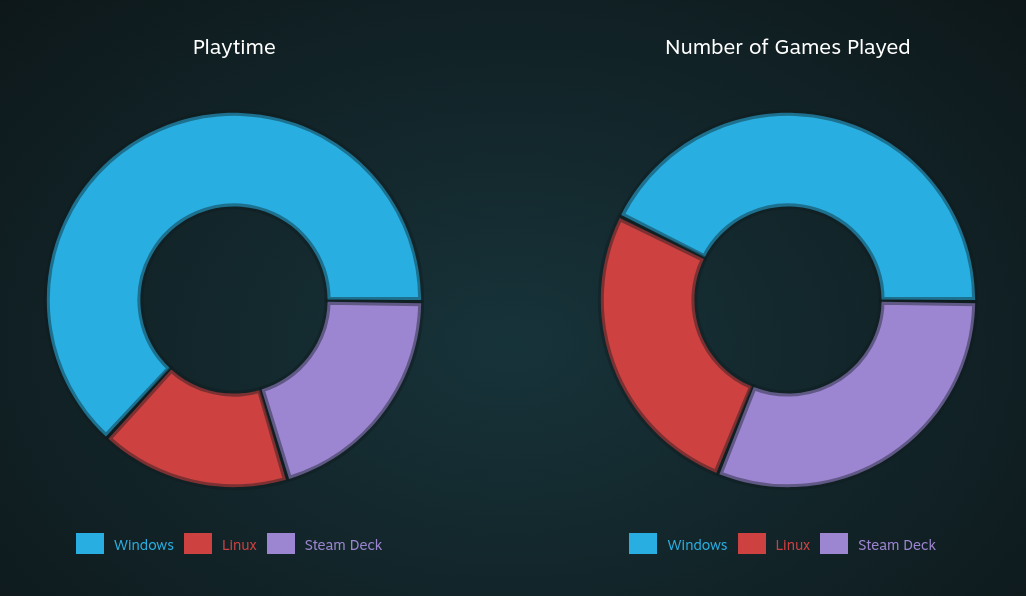
In 2022 I still mostly played PC games on Windows 10, but times were changing. In February of that year I changed jobs and no longer needed to run Citrix. My desktop Linux gaming usage increased and I finally was able to order my Steam Deck on June 30, 2022 when I got my confirmation email that I had made my way through the queue.
The Steam Deck brought Linux support to XIV launcher which mean I could start playing FFXIV on Linux desktop! However, since FFXIV playtime is not tracked by Steam, this does not impact the playtime shown above.
When Overwatch 2 released in October of 22 it was almost immediately playable on Linux through Bottles and I essentially only played on Linux. [2] The game was also not out on Steam yet so this was not tracked by my replay either.
2023 - A year of quite a lot less of windows desktop
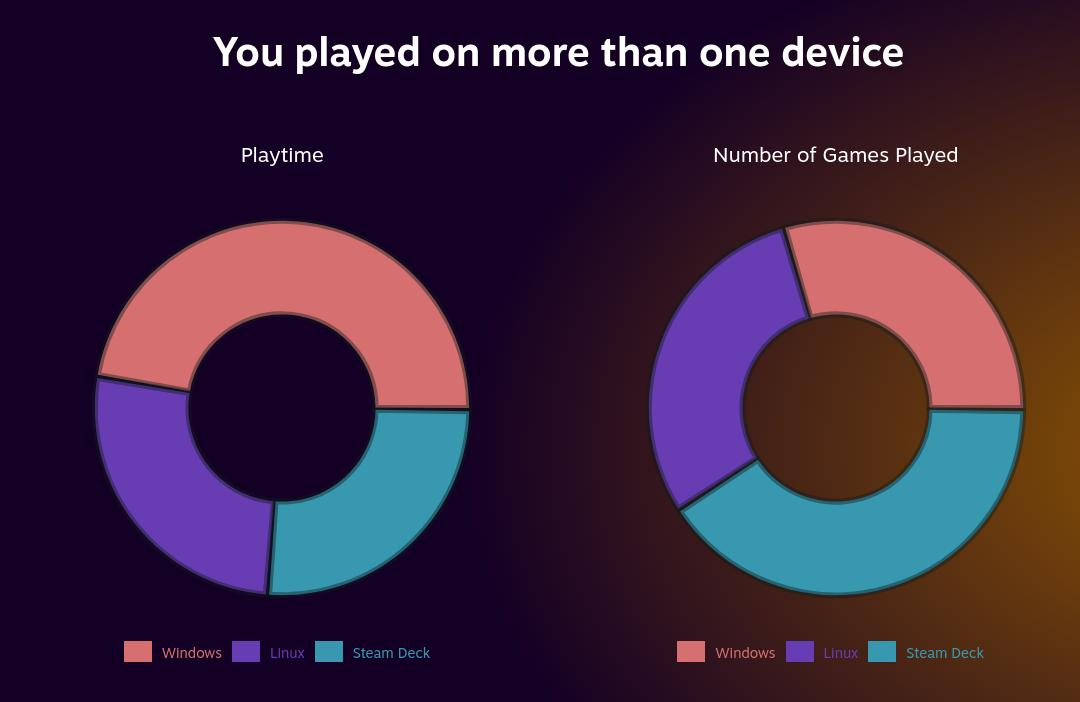
As I mentioned in my post on self hosting LLMs, in 2023 Newegg accidentally sent me a very nice AMD Radeon RX 7900 XT and never asked for it back. This was a major boon since AMD support was much better than my Nvidia RTX 3080. At this point I was booting off my my Windows drive less and less. I added an alias to my NixOS config for quickly switching between Windows and Linux.
Overwatch 2 released on Steam, so this now includes my playtime for the game.
The process for trying a new game on Linux was essentially:
- Install the game on Linux and try to play.
- If I have problems, have a look at protondb to see if there are any tweaks for them. [3]
- If that doesn't help, go to the Github issue and see if the game is flagged as broken.
- If the game is broken, install on Windows, and subscribe to the Github issue. [4]
- If the issue gets resolved, repeat the loop.
Its as "simple" as that. [5]
2024 - my first Year of the Linux Desktop for gaming
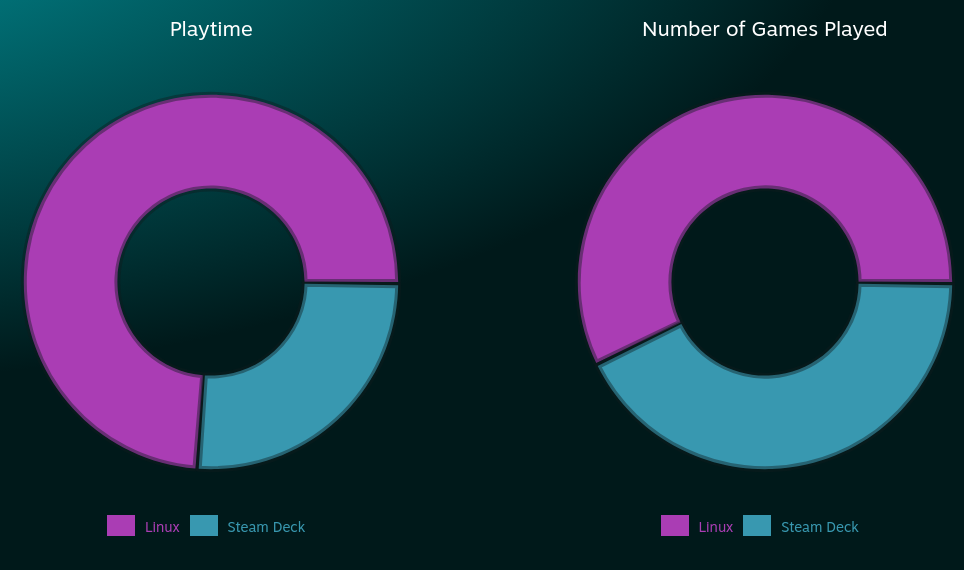
I can say with certainty that 2024 was the Year of the Linux Desktop for me. I still had Windows 10 installed on my desktop but never booted once to play a game. I pulled the Windows NVME drive from my computer at the end of the year to add a second drive for game storage.
As far as gaming habits, I had played basically every season of Overwatch 2 from 1 - 12. When they reworked Sombra around season 7, I really enjoyed playing her and had a lot of fun matches. [6] I played up until season 13 when they, rightfully, nerfed and reworked her again. I also was training for a marathon in 2024 and started recording my sessions on my Garmin watch:
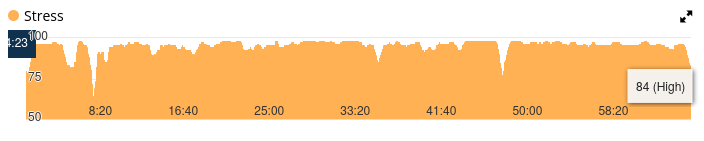
The results were eye opening, and each sweaty competitive session would result in a measurable hit to my training statistics. I took the nerf to Sombra as a chance to step away from games that involve match making so I could focus on training more.
In July of 2024 the Dawntrail expansion for FFXIV launched. I still took time off from work to play the expansion, but post launch I was playing the game less and less. The time between patches went from around 3 months to around 4 months.
Also, life was getting busier and I was spending more of my time reading. Ironically, just as Linux desktop was really finding its stride for games, I was starting to play games less and less.
2025 - my second Year of the Linux Desktop for gaming
Or more accurately, my first Year of the Linux Handheld for gaming.
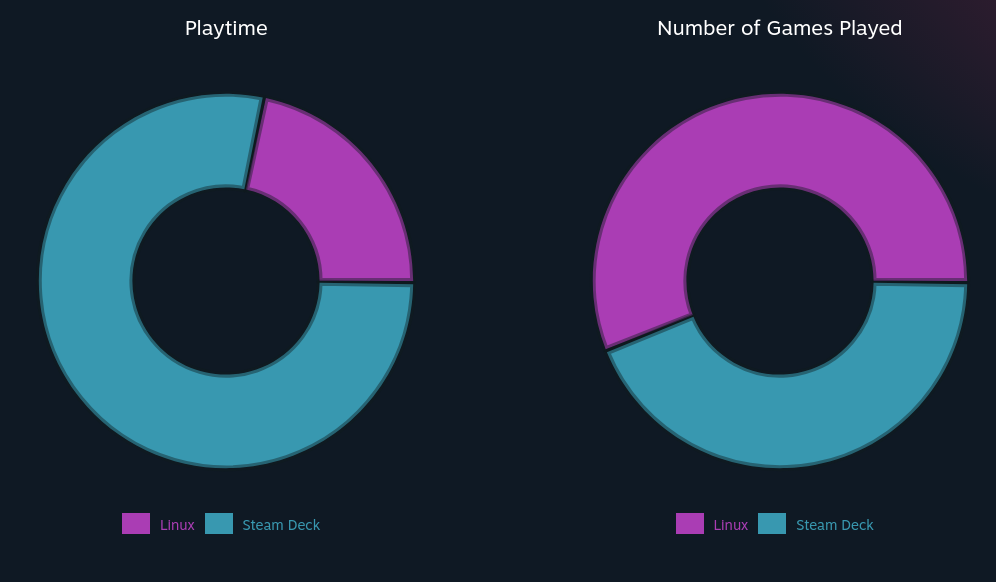
While the the switch from Windows to Linux was a deliberate choice, the switch from desktop to handheld gaming is more a reflection of my changing lifestyle.
Earlier in the year I was talking with a coworker about the amazing game Blue Prince and he mentioned that he mostly only plays games like that now. He used to have a bad addiction to Starcraft and eventually made a rule that he "doesn't play games that do not have an end". While there still are some endless games that I enjoy playing [7], I seem to have also moved in this direction without intentionally trying to do so now that I don't play OW2 and only try out FFXIV for a day or two when new patches drop. I played since the 2.0 beta, so that's 10 years of really great moments and I do not feel the need to try and extract much more.
Another change this year was actually using the PS5 I had a bit more. I bought Expedition 33 on Steam, but then ended up playing on the PS5. Ghost of Yotei was really fun too. [8] Playing on the PS5 was mostly driven by the fact that its nice to sit on the couch with my fiancée and game while she is playing on her Steam Deck. I tried running HDMI cables from my desktop, but I often only have short windows to game in the evening now, and that approach was finicky enough that I often defaulted to just picking up my PS5 controller.
I ran another race this year which means more time training, and going to bed earlier. Also, as I mentioned in my post on practicing writing, after I started reading more, I've gotten into writing for the first time in my life. Which you can see in the sharp rise in new posts this year. All of this means less time for games.
A shout out to Valve's work with the Steam deck and beyond
There are so many people that contribute to the Linux desktop and I don't want to diminish their work. I just want to call out how much Valve has invested. [9]
You can scrub through the Phoronix tag for Valve and the GamingOnLinux tag for Valve for plenty of examples. This write up circa 2023 tries to establish some of the history. I initially was going to list out all the project Valve contributed to and put together my own links to articles, but I honestly felt overwhelmed by the volume. Instead I just want to highlight how many of the different parts of the stack Valve either directly worked on or payed contractors to work on:
- Kernel level changes around futex. Also, various gaming hardware drivers.
- Mesa drivers like RADV and related parts like ACO.
- The translations layers alphabet soup like DXVK and VKD3D.
- The compatibility libraries like Proton, but also upstreaming work into Wine proper.
- Also, emulation layers FEX-emu.
- Compositor components like Gamescope and wlroots.
- DE support through contributions to KDE.
This is of course, a non exhaustive list.
This road started with Valve releasing the official Steam Linux client in 2013 [10] and their first attempt at a Steam Machine in 2015. Those devices were a failure, and devs didn't want to port their games to Linux, but Valve continued on. In 2018 Valve released Proton and worked their way to the Steam Deck in 2022. They have patiently been laying all this ground work. This interview with Valve from 2022 really helps explain their mindset. As well as this quote from the article Valve Is A Wonderful Upstream Contributor To Linux & The Open-Source Community (2022):
Griffais says the company is also directly paying more than 100 open-source developers to work on the Proton compatibility layer, the Mesa graphics driver, and Vulkan, among other tasks like Steam for Linux and Chromebooks.
“There’s a larger strategy effort to coordinate all these products and set up kind of an overall architecture, to make sure they can help PC gaming technology thrive in a Linux-based environment that is not really the target platform for all those games,” he says.
I'm making a note here, HUGE SUCCESS. [11]
Some final thoughts
When I graduated high school, my social studies teacher gave everyone a copy of the poem Desiderata. Lines from the poem will come to my mind from time to time. Right now I'm reminded of the part:
Take kindly the counsel of the years, gracefully surrendering the things of youth.
Ironically, the two major games that blocked Linux for me, FFXIV and Overwatch 2, are games I don't play much anymore. Still, its really nice to see how things have come along. I still play games, I'm just a bit careful now about how I choose to spend the time I do play.
Also I'm really excited about the upcoming Valve hardware. I own the original Steam Controller and have been thirsting for a Steam Controller 2. The PS5 Dual Sense edge mostly checks all my boxes:
- Symmetric joy sticks. [12]
- A touch pad for compatibility with games where I may need a mouse input occasionally.
- Fully programmable back buttons. [13]
- Motion controls for compatibility with games that need it.
The Steam Controller does all of that, with a more Steam native experience.
The Steam Frame has gotten me excited for VR again. I was an original backer for the Oculus Dev Kit 1 back in 2012. Then Facebook acquired Oculus in 2012 [14] and I never bought the Consumer Rift. In 2019 I grabbed a Valve Index and played with it for a while. However, having to use floor to ceiling poles to attach the Lighthouse for outside-in tracking, as well as needing to recalibrate every time I played, was enough friction that I stopped. Inside-out tracking on a open ecosystem device is something I've been waiting a long time for. Also, the fact that FEX works well enough for x86 to ARM translation is very exciting.
I don't think I'll buy a Steam Machine, but I'm very happy it will exist. I've been testing out dual booting Bazzite on my desktop and I'd love to replace that with SteamOS proper. If I can pick up a controller and play a game on Steam with my TV as easily as the PS5, then I won't need to boot that up as much.
Either way, I'm looking forward to a third Year of the Linux Desktop. Especially considering the intentional enshittification of Windows.
The game would not be flagged as playable until 2022. ↩︎
I really liked TF2 as a kid and not many other games aside from Overwatch scratch that itch. There was a month where I played Gundam Evolution quite a bit. ↩︎
Another great sign about the Linux community is projects like this to collect and share knowledge. ↩︎
I'd like to say that the fact that each game gets an issue is really nice for collecting problems. Compared to Windows where you just sort of scream into the void hoping to find someone with a similar problem. There is also the upside, that since the compatibility layer is open source, people can actually try to fix the issue, rather than waiting for Microsoft to maybe do something. ↩︎
My friends and I wanted to play L4D2 recently and wanted to get a 5 player server working. We spent two hours trying to stand up a server for it, combing forums for solutions. Each time we rebooted and the game failed to run we would say "See, its as simple as that". ↩︎
I set up a channel on my Discord server where my friends and I could post screenshots of people being upset at us playing Sombra. ↩︎
Especially, if it means hopping online to catch up with some friends. ↩︎
Especially, after going to Japan last year. I have some friends going to northern Japan next year, and Yotei has me excited to go with them. ↩︎
Turns out they want to escape Microsoft as much as we all want to. ↩︎
Which only supported Linux native games. I received a surprising amount of compatible games through Humble Bundles and played a few, but mostly stuck to Windows for games at that point. ↩︎
I'd also like to say how important this is for game preservation. There are many old games that no longer work on Windows, but will work with WINE! ↩︎
I know this is controversial, but I very much prefer it. ↩︎
SCUF's lawsuits against anyone that tries to use back buttons on a controller without paying this is absolutely criminal. ↩︎
Which also was a huge bummer since John Carmack used to share a lot of detailed technical talks and stopped doing those. ↩︎
Member discussion