I Read a Couple of Books in 2025
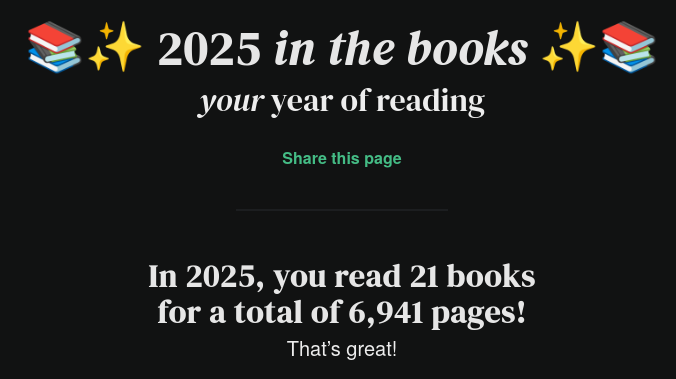
As I mentioned in my post on practicing writing, I started reading more a couple of years ago when my grandfather passed. Another year has gone by and I wanted to reflect on how this new habit from him went in 2025. This post is about the books I read. See my other post for the books I listened to.
I have a Goodreads account, but I keep my profile private and do not review books there. Instead, I use the site more for keeping track of when I've finished books. Also, this year I started tracking on the fediverse version of Goodreads, Bookwyrm, but I also do not post there. POSSE as they say, so here are all my reviews that are due.
Also, I like to make highlights in Readwise Reader. [1] I have a "useful" tag I put on highlights that really impacted me. So I'll sprinkle some of those highlights throughout the reviews.
DRM and books
Note: I am not an affiliate, and I do not use affiliate links. If I link to a book here, its because I'm excitered there is a DRM-free version available.
Anyway, having said all of that I wanted to talk about how I source my books. If a book is available on bookshop.org [2] and the book is DRM free I will buy the book there and load the epub into Reader. I'll also backup the book onto my server.
If the Audiobook is on Libro.fm, I will buy the book there to support the author, and a portion of the sale will go to my local bookstore. All books on Libro.fm are DRM free, and I want to support that ecosystem when I can. I use their 1 credit a month plan and spend those credits on books that are more than $14. I'm looking at you Brandon Sanderson.
I usually download the audiobook files and upload them to my Audiobookshelf instance I self host. On Android the official app works really well, even with Android Auto [3]. The iOS app for Audiobookshelf has been stuck in testpilot forever with no open slots, but AudioBooth is a great FOSS option and SoundLeaf is a reasonable paid option.
Audiobookshelf is great for audiobook listening on roadtrips where either of our phones could be connected to the car. The official Libro.fm app is a nice backup as well.
Finally, if those fail, I will try to grab the books off of Libby. Having to wait for books to be available and having a limited about of time to read the books creates some friction, but the Libby app can still sync highlights with Reader.
I read a lot of Cal Newport this year
Slow Productivity (2024) by Cal Newport, 216 highlights [4]
I read Deep Work (2016) and Digital Minimalism (2019) last year. Deep Work was really a core thesis for Cal. In his following books he builds on smaller ideas from the book and expands on them. Slow Productivity is:
A philosophy for organizing knowledge work efforts in a sustainable and meaningful manner, based on the following three principles:
- Do fewer things.
- Work at a natural pace.
- Obsess over quality.
And what he advocates for is:
the core idea that this book will explore: perhaps knowledge workers’ problem is not with productivity in a general sense, but instead with a specific faulty definition of this term that has taken hold in recent decades.
I found his ideas to be really practical and like his other books I've started using many parts in my day to day.
How to Become a Straight-A Student (2006) by Cal Newport, 278 highlights
This is a much earlier work by Cal and its cool to see how his writing style has changed over the years. I read this book after his more recent books because I was planning to take some courses and realized that I had never really thought about how to take a course growing up. I really wish I had a book like this when I was younger. So much wasted time spinning my wheels on poor ways to study.
Anyways, I did a course on photography through RISD before my trip to Japan where I used my Ricoh GRIII and this book was really useful.
So Good They Can't Ignore You (2012) by Cal Newport, 103 highlights
This book is based on the idea that the normal recommendation to follow your passion fails most people. Instead, Cal talks about working on "the craftsman mindset" and the need to work on building up rare an valuable skills. This will help you build up career capital, which in turns helps you control what your work life is like.
This is also his first book I read that really explains deliberate practice, which I talk about in my post on learning Rust.
Time Anxiety by Chris Guillebeau, 222 highlights
I heard about the book through this episode with Chris on Cal's podcast. The writing style threw me off a bit, but I like how compassionate the author is. I took a couple recommendations from the book and use them in my day to day.
I trained for a Triathlon sprint that I never ran
This year I shared a post about my experience training for the Boston Run to Remember Half Marathon. What I haven't talked about yet was that I planned to do a triathlon sprint in October, with a friend, but then never ran the race. My friend had to get knee surgery, and I myself was feeling overtrained trying to swim for the first time, and balance training for all three events. So we punted to next year. The up side is I read a lot of good books.
Training and Racing with a Power Meter: Third Edition (2019) by Hunter Allen, 169 highlights
While this book was really interesting, I feel like I didn't take much practical knowledge away from it. The author goes deep into the details of all the metrics like Intensity Factor and Training Stress Score that you would see in your training apps. However, the main lessons were about how to find your training thresholds, and how to use them in training. If you pick this up, make sure to grab the most recent edition since the technology behind power meters moves fast.
After reading the book I bought a power meter for my bike. Also see my post on modifying my stationary bike to work with SmartSpin2k.
The Cyclist's Training Bible: Fifth Edition (2018) by Joe Friel, 344 highlights
I like this much more than the previous book. The focus is much more practical:
The most crucial take-home message is that you need a standard weekly and daily routine that allows you to fit everything important into your life in the order that reflects your priorities. You’ve got some level of responsibility to other people, including immediate family, relatives, employers, teachers, coworkers, classmates, friends, teammates, and others. Fitting only these responsibilities into your life is difficult. Also fitting in training that meets the demands of your goal makes establishing a daily routine extremely challenging. So your goal must be realistic with regard to your life. And the higher the goal, the more important it is that you have a standard lifestyle routine in order to produce the desired result.
I handle my training plans through TrainingPeaks and the Joe co-founded the company TrainingBible. Ironically, Allen founded CyclingPeaks and the two eventually merged to become training peaks. I didn't realize this before I picked up the two books.
Run Like A Pro (2022) by Matt Fitzgerald, 220 highlights
I read Matt Fitzgerald's books 80/20 Running and The Endurance Diet in 2023 when I trained for my marathon. I also used his training plans through TrainingPeaks for both the Marathon and Half Marathon.
This is a much more recently written book, with a focus on adjusting his recommendations for recreational running. He touches on all the major topics like training intensity, strength training, nutrition, sleep, etc. I do not see this as a replacement for his older books, rather as a complementary addition.
80/20 Triathlon (2018) by Matt Fitzgerald ??? highlights [5]
Prior to this book I had an idea how to periodize running and biking, but not both at the same time, and certainly not both while also swimming. This book breaks down that problem in a really clear way. Now note, that doesn't make the task of triathlon training any less daunting, but the structure does set you up for as much success as possible.
I also used the 80/20 triathlon level 0 training plan, so this book was required reading. [^ I used the version with HR based running, pace based swimming, and power based cycling. I love that there is a version that lets you use all three types!]
Peak Performance (2017) by Brad Stulberg, 166 highlights
I thought I felt tired during the marathon training, but that was actually nothing compared to how I felt on the triathlon plan. This book doesn't tread any new ground compared to other books I've read, but it does a great job of pulling together and summarizing all the standard advice around training cycles and recovery. This was a nice refresher for me, and I think it would be a nice introduction for someone new to the space.
As a side note, I read the Seven Day Sleep Prescription during my marathon training and my recovery improved significantly. [6] Another side effect of this is that I now read before bed as a part of my wind down ritual. I typically only need to read for about 15 minutes before turning off the lights, but the page count really adds up over time.
Outlive: The Science and Art of Longevity by Peter Attia, 514 [7].
I listened to the audiobook version last year during my marathon training, but I revisited the book again this year so I could highlight and better retain the information. Man does this book have a lot of information. The chapters include a combination of science, and stories to explain the science. Since this was my second time through I only skimmed the more narrative sections.
The core thesis is that we often treat conditions far too late in life. [8] Instead, if we make lifestyle changes earlier we greatly reduce our risk of "the four horsemen": heart disease, cancer, neurodegenerative disease, and metabolic disfunction.
Also, Attia acknowledged that he promoted narrow viewpoints when he was younger and that this book was partly a way to correct that. I love seeing someone demonstrate introspection and growth. I also appreciated him including a chapter on the importance of mental health, and sharing personal experiences with his own struggles that he has worked through.
Tactical Barbell I (Second edition), by K. Black, 140 highlights
I adopted a dog this year and while I was adjusting my schedule I didn't get to the gym much. So I reread Simple and Sinster by Pavel and ran that at home since the workouts are quick and you only need kettle bells. The workout is my resistance training fallback when life gets hectic.
When I had time to start going back to the gym I ran a couple Tactical Barbell templates because I previously ran Wendler's 531 in the past and wanted something similar, but a little lighter. I'm not into the whole military theme, but this program kept coming up as a good option to sustainably combine with cardio endurance training without burning out.
I'm happy I also sat down to read the book, because it spells out the philosophy well:
If strength is very low on the list of priorities for you but still needs your attention, you might choose a minimalist exercise cluster to go with Fighter template. This is a very popular combo for endurance athletes such as marathoners or triathletes.
For now I've been running the Fighter template so I can get two days a week doing resistance training, and I've been able to hit my recovery needs. [9]
Also he spelled out the golden rule very clearly:
THOU SHALT REST A MINIMUM OF TWO MINUTES BETWEEN SETS
Not a minute, not 90 seconds. Not even if you feel completely rested before the two minutes is up. Don’t trust your body in this case. Notice the Golden Rule states ‘a minimum’. That’s right. The idea is that you are fully rested for the next set, so that we avoid muscle failure. Take as long as you need, as long as it is a minimum of two minutes.
Increasing my rest time so that the workout is focused on maximal strength has really gone a long way for helping my day over day recovery.
Tactical Barbell II: Conditioning by K. Black, 112 highlights
Since I have experience with cardio programming already, this was primarily helpful for figuring out how to program the strength work alongside the cardio endurance. I also like the focus on training efficiency:
First, you have to know how to train each system in the most efficient manner possible. Efficiency becomes important, because as a multi-tasking athlete you can’t afford to lose training time or energy doing things in a less than ideal manner. You have to master multiple skills. Your time and energy are going to be tight and precious... Choose fewer, but more effective tools.
Ageless Athlete by Jim Madden, 158 highlights
This is what happens when a philosophy professor reads the tactical barbell books:
I also have a very low tolerance for the “tacticool” fitness trend. I loathe products aimed at civilians with titles like “Warrior Fitness” or “Train like a SEAL.” If you want to find out what it is like to be a warrior, there are several active “government programs” that would be happy to let you try out the real thing!
While this is more for people in the 40 plus age range, the book was still worth reading. He builds on the ideas about sustainable and efficient training from the previous two books. There is a little more emphasis on strength over cardio than I would like, but he gives you all the tools to adjust the ratio if you want to. Especially the pieces on seasonal training. I now have options around shifting cardio and strength work in the winter.
He gives reasonable advice focused on exercise over the long haul, rather than chasing PRs right now and blowing yourself up. This book ties in nicely with the other books I read this year.
I read some books about the internet now a days
Superbloom by Nicholas Carr, 178 highlights
I can't remember where I saw this recommended. I remember enjoying this book while I was reading. Looking back now, I don't remember taking much away though. I think that is because the content overlaps with a lot of other material I read. This book would be a great introduction for people new to the topic.
The Internet Con by Cory Doctorow, 170 highlights
I got to see Cory Doctorow at PyCon this year and wanted to pick up one of his books. At that time The Internet Con was his latest so I started with that. On the whole I liked the book and how he addresses specific policy problems with specific potential solutions.
Enshitification by Cory Doctorow, 252 highlights
This is Cory's newly released book. A lot of the material is going to be familiar if you are a regular reader of his blog Pluralistic. However, the book collects and organizes the content really cleanly:
- First a tour of the history of how we got the Enshitified internet.
- Then talks through the pathology, the processes that led to Enshitification.
- The epidemiology, the causes of "how competition, regulation, interoperability, and worker power all slipped away."
- Finally he talks through the "cure".
Out of all of the sections I really appreciated the final one on the cure. That felt the most novel compared to what I usually read on his blog.
Repair revolution [10] by John Wackman, 123 highlights
This year I went on a road trip for a wedding. On the way I stopped at Grassroots Kitchen in Tarrytown, NY. On their bookshelf they had this book which introduced me to the concept of Repair Cafes.
It includes a lot of examples from actual repair cafe events. Those parts felt a bit much and I often skimmed them vs the more explanatory parts of the chapters. The rest of the book on the history and ethos of the movement was compelling.
Hello, My Name Is Ice Cream: The Art and Science of the Scoop: A Cookbook by Dana Cree, 172 highlights
A friend who makes ice cream recommended this one. The book both gives a clear explanation of the science behind ice cream making and provides a framework. This will allow you to create your own ice cream going forward. For me, this means modifying recipes to be low FODMAP for my fiancée. [11]
If you are interested in learning about ice cream I highly suggest starting with this.
Here Comes the Sun by Bill Mckibben, 146 highlights
This was enthusiastically recommended by Cory Doctorow. The book was a really digestible read. Equal parts encouraging and demoralizing:
- paints a really clear picture of how the economics have shifted in a way that makes solar and wind inevitable. [12] No matter how much the fossil fuel industry wishes that was not true.
- By stepping away from renewables and doubling down on fossil fuels the US has given up its opportunity to be a global leader. No matter how much people wish that was not true.
I recommend this as a read for anyone that wants to be able to explain to others why either of the two above points are true.
The Daily stoic by Ryan Holiday
I read this on recommendation from my Therapist. The book is set up to be read one page a day. The structure gives you time to take all the content in and try to integrate the practices. I missed a couple of days here and there, but I know I will catch them in future years when I repeat the book.
Also, each month of the book has a theme and not all of the themes hit for me. However, on the whole I'm happy I read the book.
The lesson from December 22 stood out to me:
It’s easier to quote, to rely on the wise words of others. Especially when the people you’re deferring to are such towering figures!
It’s harder (and more intimidating) to venture out on your own and express your own thoughts. But how do you think those wise and true quotes from those towering figures were created in the first place?
Your own experiences have value. You have accumulated your own wisdom too. Stake your claim. Put something down for the ages—in words and also in example.
Yes, I know the irony to quote these lines and to use the other quotes I have in this post. This is a nice reminder to write my own words when I can.
I not only read books, but also...
Newsletters! I wanted to call out a couple other pieces of long form content that I consistently read over the years.
As I mentioned in my post on converting article HTML to SSML for Text to Speech, I use to run a custom program for turning Matt Levine's Money Stuff newsletter into an audio podcast RSS feed I could listen to. Now a days I'm using the TTS feature in Reader instead, but I still listen every time he publishes. [13]
Similar but different is the Bits about Money newsletter by Patrick McKenzie. [14]
Finally I started reading Cory Doctorow's newsletter Pluralistic this year after I read his books.
In progress and on deck books
I have too many books I am currently reading:
- Seeing Like a State - a heavy tome that will take a while.
- Climate Obstruction: A Global Assessment
- Style: Lessons in Clarity and Grace
- The Hardware Hackers Handbook
I have too many books I want to read:
- Two recommended by the Economist, Is a River Alive? by Robert Macfarlane and Lone Wolf by Adam Weymouth.
- Steps to an Ecology of Mind by Gregory Bateson
- The Origins of Efficiency by Brian Potter of Construction Physics
- Bird by Bird by Anne Lamott
And so, so many more.
In a recent podcast episode Cal Newport answered a listener question about how to manage one's lists of what to read and watch. What he said really resonated with me:
The way I see it is, look, do I always have something interesting to read? Yes. Do I have no shortage of interesting things to watch when the time comes around? Yes. Do I have no shortage of podcasts to listen to when I have downtime? Yes. Then I'm happy, because the problem is I make a list of all this stuff, and then I feel lost for not doing the things on my list that I haven’t gotten to. But the lists, technically speaking, could be unending. I mean, there's no shortage of books you could be reading. There's no shortage of visual content you could be watching. So, why create loss, right? I'm just like, what am I excited about? Let me do that now.
So I'm pretty set for good books to read into the future.
I've been using a Boox eink android tablet for a little over a year now. I like that I can run regular Android apps like Reader. On the whole things work pretty well! ↩︎
A portion of the sale will go to my local bookstore. ↩︎
Though if you install through fdroid or Unobtainium you will need to enable unknown sources similar to Antennepod. ↩︎
I don't have a specific reason for including the highlight count. Its not a great signal since the length of the books can vary so much. ↩︎
Due to availability issues I had to buy this through Amazon. In the past I could export using the "Download & transfer via USB" option and strip their DRM using DeDRM and Calibre because I had an old Kindle device. However, that no longers works so I had to read through the Kindle app and while I though I had exported my highlights into Readwise, I actually only see a couple in there. ↩︎
Speaking of which, I noticed while writing this that I was nearing my wind down for the night and stopped writing for the even. One habit that I built thanks to that book. ↩︎
Ok, in this case I do think the highlight number is meaningful. ↩︎
Especially in America. ↩︎
Its a bit of a hike to get to the gym. One day when I can set up a home gym, I'd love to run a 4 day a week, but shorter session template like Operator. ↩︎
I keep saying I'll write a post on this, but there is only so much time. ↩︎
Its hard to beat the learning curve for silicon. ↩︎
Which used to be most weekdays, but not Fridays there is a podcast on Fridays. ↩︎
Member discussion