NixCon 2026 Day 2

| These notes are a little raw, I'll come back to clean things up after the conference. |
|---|
As I mentioned in my post on swap, zram, zswap and hibernate, I went to NixCon2026 at Jagiellonian University in Krakow! I thought I didn't have an open weekend to do a conference like PyCon and NeurIPS last year. Then about two weeks ago I had some plans fall through and work was able to fast track the trip approvals.
This was the first time the conference was for days long. They added Friday and Monday as hack days. There was a good turnout yesterday for the hack day, but I was indisposed from the red-eye flight and could not make it. So this is day 2 of the conference, but the first day for me.
I'll put the more meta commentary into a retrospective post after the conference.
Opening ceremony
The schedule changed a bit on the morning of, but the day still started with the opening ceremony.
This was the 9th NixCon and there were lots of first-time conference attendees like me.
NixCon started with 75 Nix nerds meeting in Berlin. There is no word yet on where the conference will be next year.
Also, the steering committee election is on. I did not meet the minimum commit requirement this year. Hopefully next year.
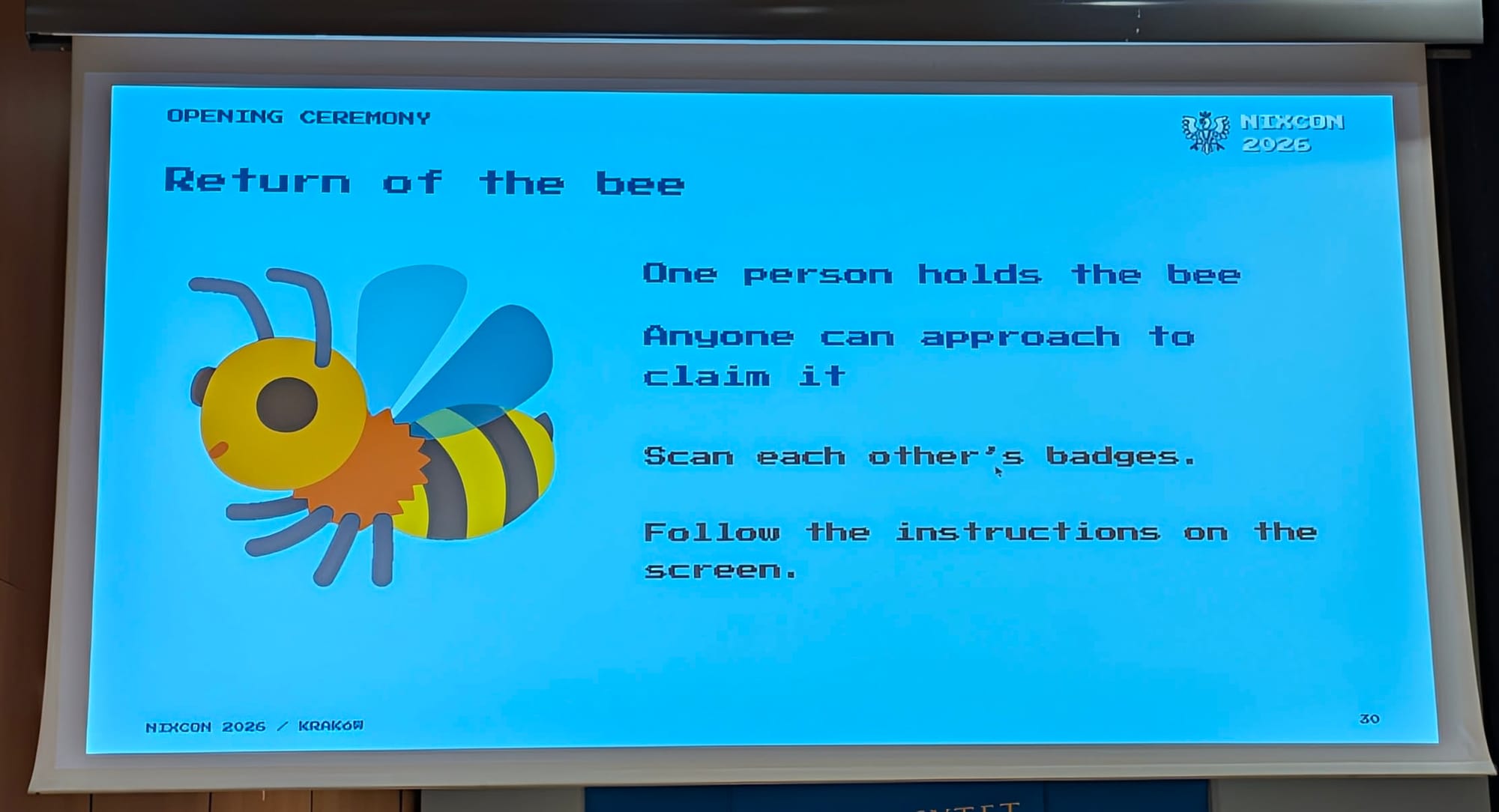
Also, also, there was THE BEE:
Nix State of the Union 2026 - NixOS Foundation
The State of the Union started off with Ron Efroni, the president of the NixOS Foundation, giving some updates.
When polled, about half the audience said this was their first year at the conference. There was even a pretty large pool of people at the conference that had only been using Nix for half a year.
When asked who has convinced a colleague to use Nix, a surprising number of hands went up. I have not convinced any, but there are a few at my work that independently chose to use Nix.
The foundation has to do taxes and the boring accounting. They mentioned the 2025 financial report and that NixCon 2025 was 35% of the spending. This year's con will likely be a big chunk too. Most of the funding is through donations on opencollective.
Ron said he's looking at a long horizon to keep things working. Specifically with contributors, governance, and resources. "We're not perfect, we have a lot to build, a lot ahead of us... We didn't have that five years ago."
He has a specific focus on the effort to value ratio. Learning Nix isn't a linear process where more effort immediately leads to more value:
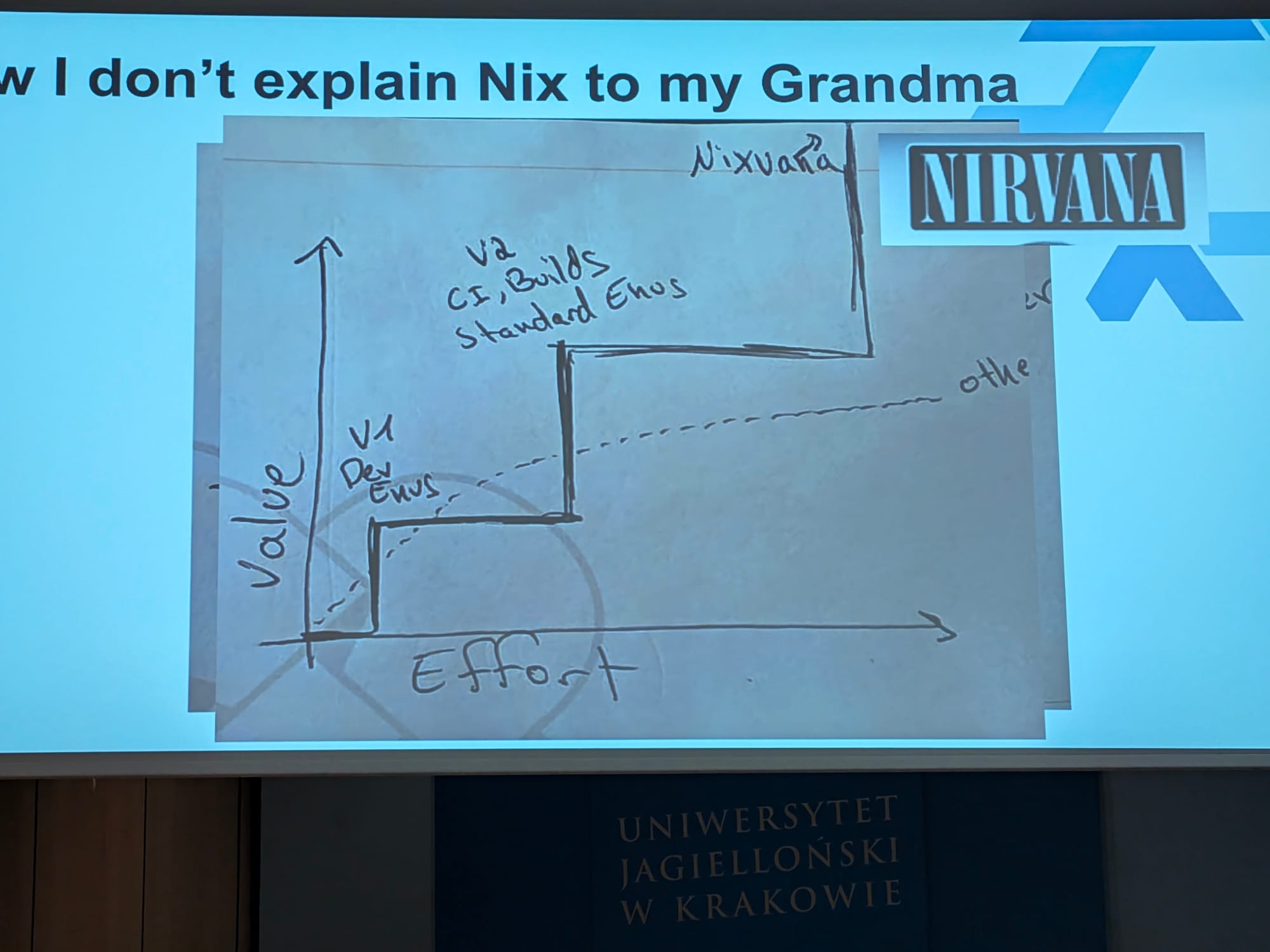
Nix doesn't work that way and he wants to set expectations for new people. It's much more of a step function. There are deserts of effort:
- Dev envs
- CI and builds
- Finally "Nixvana"
That really struck a chord with me. I've mostly used Nix to consume packages, and I'm slowly working my way through the second step for CI and builds.
The cache is big now and they are putting out an article on that soon:
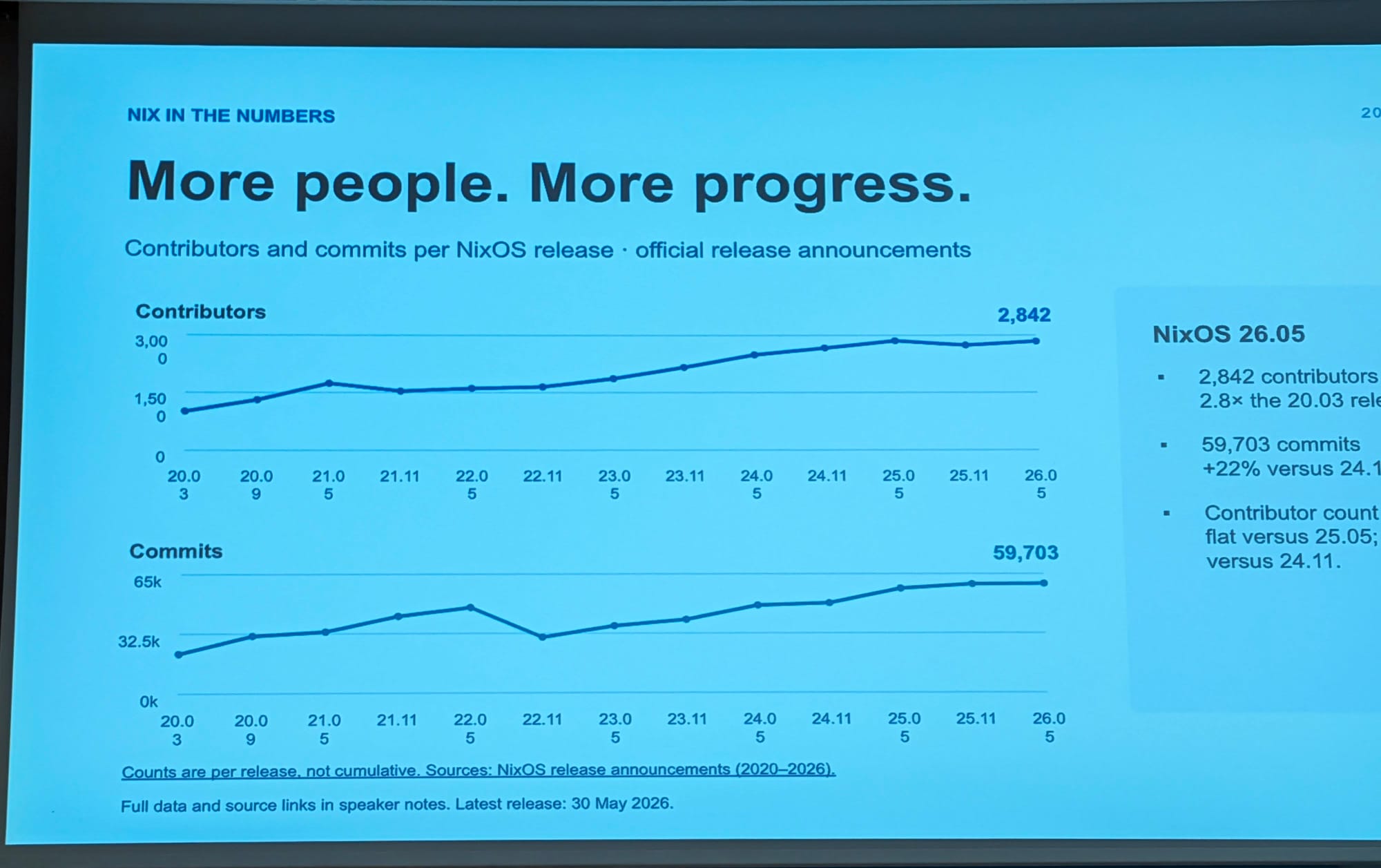
Thankfully, the foundation got another year of funding from AWS for the entire cache. In 2024 they had a 50k charge before they had the funding. The foundation also got 300k in funding from a pool of companies! The biggest contribution they have gotten so far.
Related is a new proposal for team initiatives and grants with purpose-bound funding. This will help with deploying the new funds. The NixOS Foundation org is managed on git and there is a pull request covering this proposal.
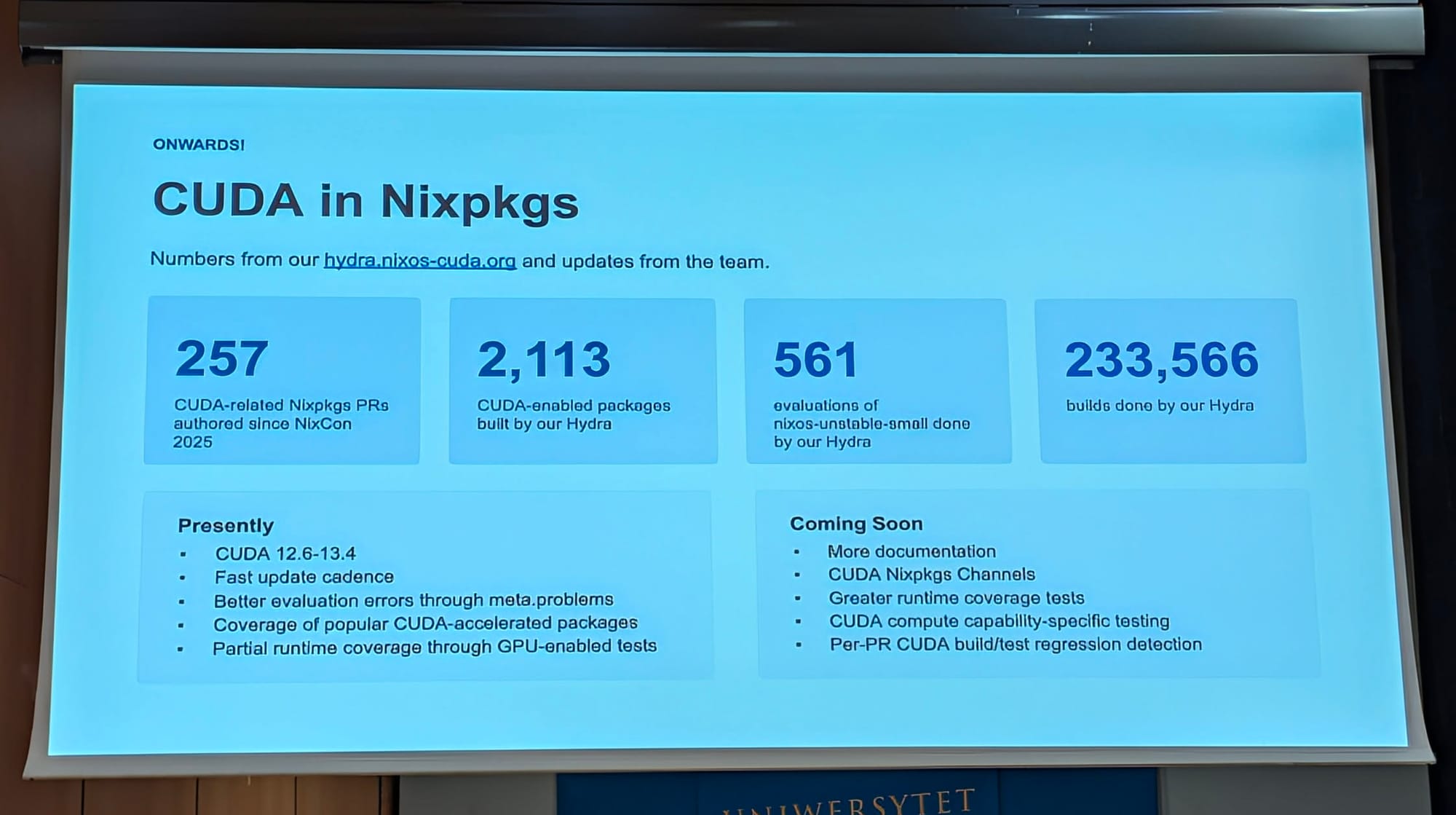
Some folks from NVIDIA and Mistral were there on their own initiative. I didn't realize there are ~2k CUDA enabled packages:
Finally, Flox announced an official kickoff to fund Nix on Windows. They are currently in talks with the teams at Microsoft.
State of the Union - Steering Committee
The next part was the steering committee giving some updates. k900 could not make it since they are "in the zone that you can't leave."
They were only informed they needed slides the night before but valiantly put some good details together.
The committee really wanted to use the time to give an honest talk about where they fell short. Especially in the context of four members finishing their terms and elections coming up. People got really heated over Nix decisions in the past. It's easy to yell at people when they are abstract usernames online. This talk really humanized the situation and is a great example of why I'm happy I attended.
In their view, longer term planning hasn't yielded results yet. They say the next SC shouldn't just be showing up, and should actually be steering. A big part of making this work is being honest about how much time the members can devote. It's easy to overestimate how much time you can actually put in. They admitted they didn't meet the standards of good governance.
They highlighted some positive changes they made: added open meeting notes and open vote results. Especially for sponsorship decisions. They have an open policy in the repo now and task tracking through a public Zulip.
This was a year of learning and getting better. "We have all this process now, but what are we doing with it?" What's next is up to you. The concesus is that showing up matters, in direct reference to the Nix Derverses Great Governance. They would rather not be stuck in their ivory tower. At the same time, turn over can be brutal and they need to better handle burnout.
Home Manager is now official! In general the SC wants to offer a place for any project that wishes to be official. They don't have a process for it yet, but they want people to speak with them. Also, the boundary is porous: you don't have to stay if it's too much, but the offer is open.
State of the Union - infra team, security team, marketing team
The security team - They couldn't make it to the con but are currently looking for help and interested people should reach out.
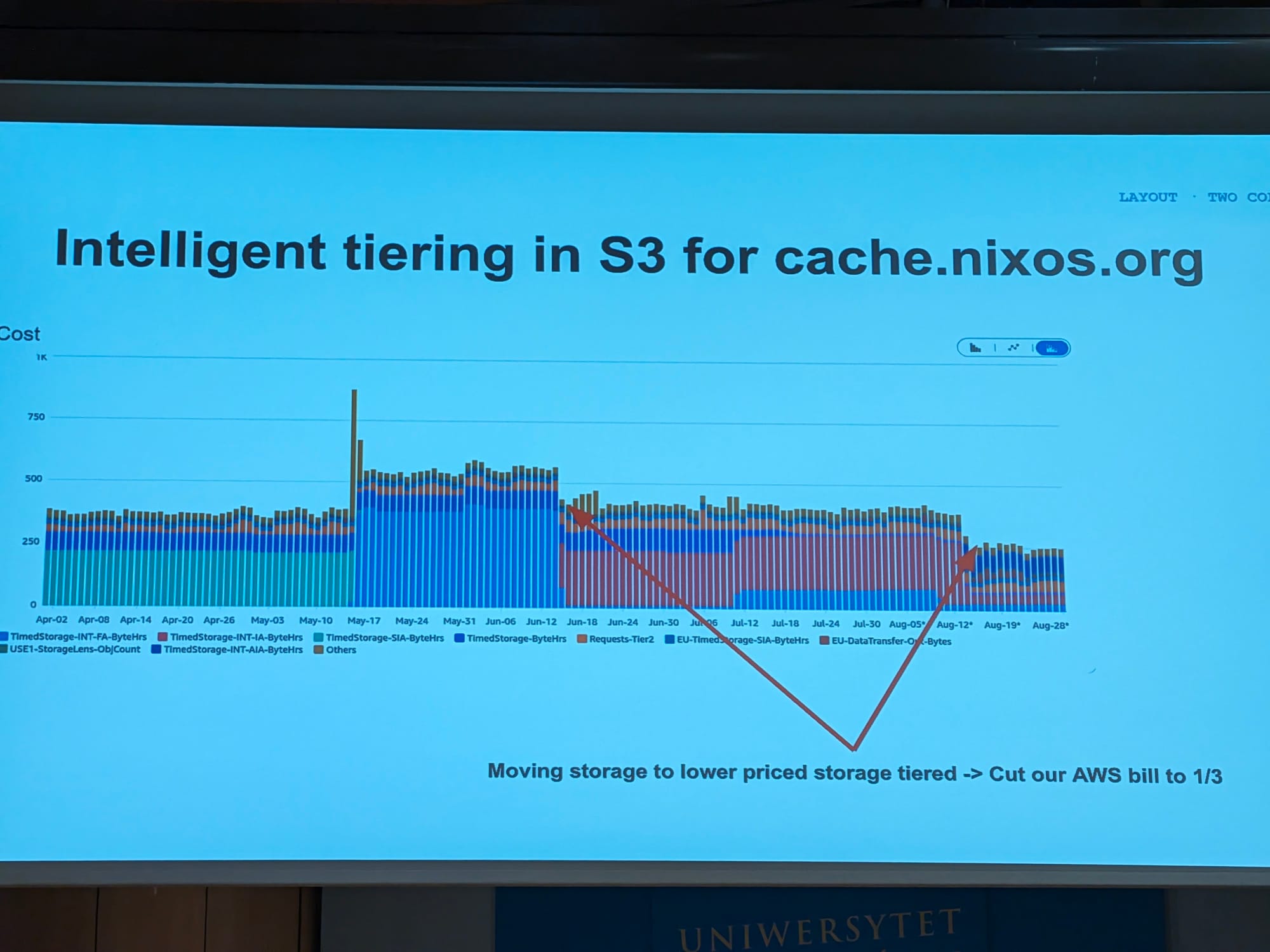
Infra team was able to reduce the AWS bill by using tiering:
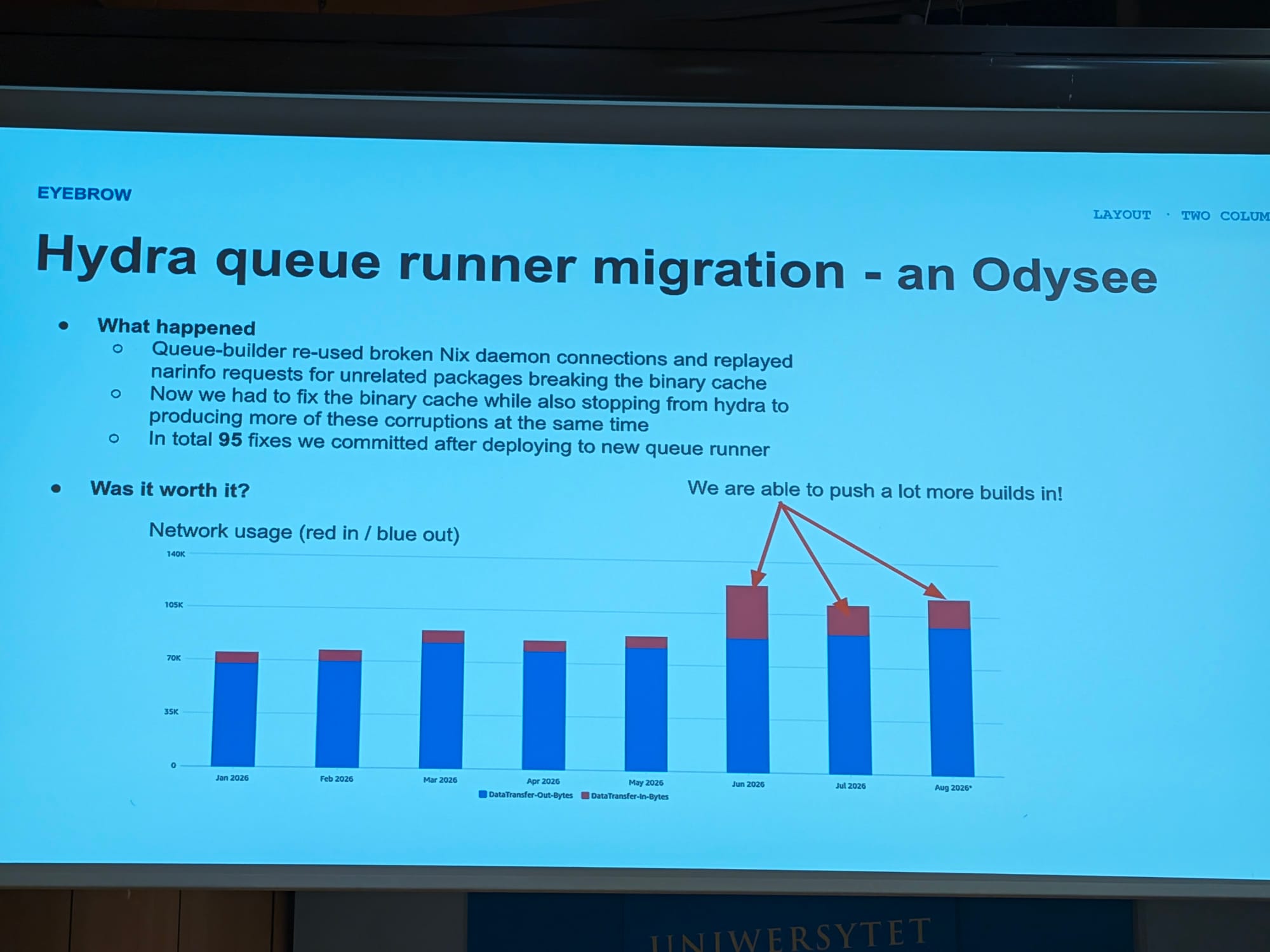
Plus, with a new hydra queue runner, they can now push a lot more builds out:
They also moved their Mac Mini fleet to Flying Circus. x86_64-darwin support was dropped since macOS is dropping support, but the upside is that there are no double builds, which saves build time.
One of the marketing team's roles is to help with the website. Survey results now get digested, and plots are added to the home page. They also made surveys easier to make with new tooling. They're using some machine translation for surveys, with PRs to help get human feedback on whether they are correct.
The team now has some members with backgrounds in journalism. They want to revive the newsletter and maybe do a podcast.
The documentation team was at the end and only had 2 minutes to talk, which is a bummer since they are the team I'm interested in engaging with. The team is not primarily writing the docs since they need people who are making the changes to keep things up to date. They are there to help you write good docs and review what you write. Right now there is lots of quality content all around, but no one can find it.
NGI Forge - Software Distribution Platform for NGI projects
Europe is looking to move away from American technology companies. The French government is putting together DINUM to test out Linux using NixOS.
I think that's awesome and wanted to sit in on this talk to hear something in a similar vein.
NGI Zero is the consortium of EU nonprofits led by the Dutch NLnet Foundation. They support different projects, including the NixOS Foundation. Together they fund and organize programs like the Summer of Nix.
NGI Zero has 1000+ packages now and wants to find a way to sustainably maintain them. They want to help upstream devs/contributors by giving them tooling. So they started on NGI Forge to reduce the initial time to get software packaged up by a non Nix audience.
The idea is you offer a recipe file with a package source and a hash. Then they have builders for npm, Python, Rust, and Go projects that follow normal conventions rather than writing full derivations. Finally, you specify how the tests run to validate the build. Additionally, for applications, you can specify the metadata for the desktop entry.
For services, you only need to specify a bit of information. This is probably the most significant difference compared to Nixpkgs. They think the hardest part is not the package derivation but the module setup. That requires deep knowledge of Nix. You can also test out services with sandboxing using Bubblewrap.
NGI Forge also has a catalog you can browse online that lists all the packages they have added. Each package's page provides the single command to run through Nix in either a container or on NixOS.
Nix Foundation and Steering Committee Panel
This was a packed panel. Take a look at the video if you want to know who said what. They didn't get many questions, so they used this time to do some community outreach.
They started by clarifying their roles:
- The NixOS Foundation board is the financial administrative side. Many board members spend on average a day per week of their time towards Nix.
- The steering committee - on the community side, handles any drama that comes up in the community. Sponsors are now approved by the committee. Many SC members are more around half a day a week but wish they could dedicate a full day.
Someone said that there are two Nix:
- The technical ideal that transforms software builds.
- The community which dedicats time and energy to the human institution.
To help with the second they said we (the community) often aren't kind to each other and could be kinder. We should respect each other more. We are good at saying no to most things for many trivial reasons. We should be good at saying yes to the big things.
On the technical side, Nix frequently gets feedback on how to be better but doesn't have the process to turn that into a more satisfying experience.
Ron said that on accountability, top three things in his mind are:
- Handling burn out better. There are a handful of folks that big organizational components depend on.
- He also echoed that the board is not good at making decisions.
- We need to empower teams to make decisions more, both non-technical and technical. Ultimately for big decisions like Flakes we can be more comfortable at failing and iterating.
They noted that Nix is now an older project with not enough new people, and we're getting a little grumpy. We should want more new people and make a space for them. We also need to be better at growing new community members. That requires empowering people to make decisions on their own.
There was an audience question: how to balance welcoming new members with responsible AI usage?
It was noted that people have strong opinions on the topic. Especially problems like "slop grenades". Eg ask Claude to make a giant PR and lob it over the fence. Because of moments like that, people will be purely for or against AI. Instead, we should think of AI as having harms and benefits. It's something that needs to be used responsibly.
We should be able to respond "what you have sent here is extremely difficult to review" but you should not insult them in the process and explain how to fix the situation. At the same time there is a point where submitters are being unreasonable and it is fine to stop engaging.
Even before AI people would open giant PRs that were unreviewable. It's just faster now. Very similar to my thought that Agentic Engineering Is Just Everything We Haven't Been Doing.
They said that ultimately the thing we need to do more is ownership and transparency.
DeltaNAR - Space efficient Nix deployments for space
adisbladis is a big name in the Nix space and did a lot of nice tooling like uv2nix. He had done some work for a space company called OroraTech that monitors natural disasters. NixOS in space!
Bandwidth to the orbital computers is very scarce, literally MB per day. Whereas Nix deploys are pretty bandwidth intense. So he created DeltaNAR to solve this.
Nix is space inefficient by default due to the store. The hash system helps solve the version collision problem with dependencies but takes up space. It also causes cascading rebuilds when there are changes. Eg if glibc is updated, everything downstream is rebuilt, even if the old version is binary compatible.
Currently deploys use Nix Archives (NAR) which are essentially less fancy tar files that works on the unit of a store path. DeltaNAR looks inside the store paths. It locally diffs the store and then sends the diff instead of everything like Nix copy.
DeltaNAR also reuses identical content using a coarse match on directory, file, or chunk (FastCDC) hashes. That way you do not need to resend matched content. It does this by recording more fine-grained details in a SQLite DB and then using BLAKE3 for hashing.
If a directory matches we can entirely skip everything inside it.
The chunking is especially useful because ELFs will have the same header at the start of all versions. Chunks are sent in reference to what you already have. Only raw chunks cost bandwidth. Missing chunks are usually near misses, so you can pick a reference chunk and diff against it.
Aside from space, similar steps could be applied to the regular Nix copy protocol to make it more efficient. The downside is this puts more work onto the sending machine.
Mainstream Nix - Native Windows Nix, Language PM Nix Backends
Joachim Schiele has been working on Nix since 2011:
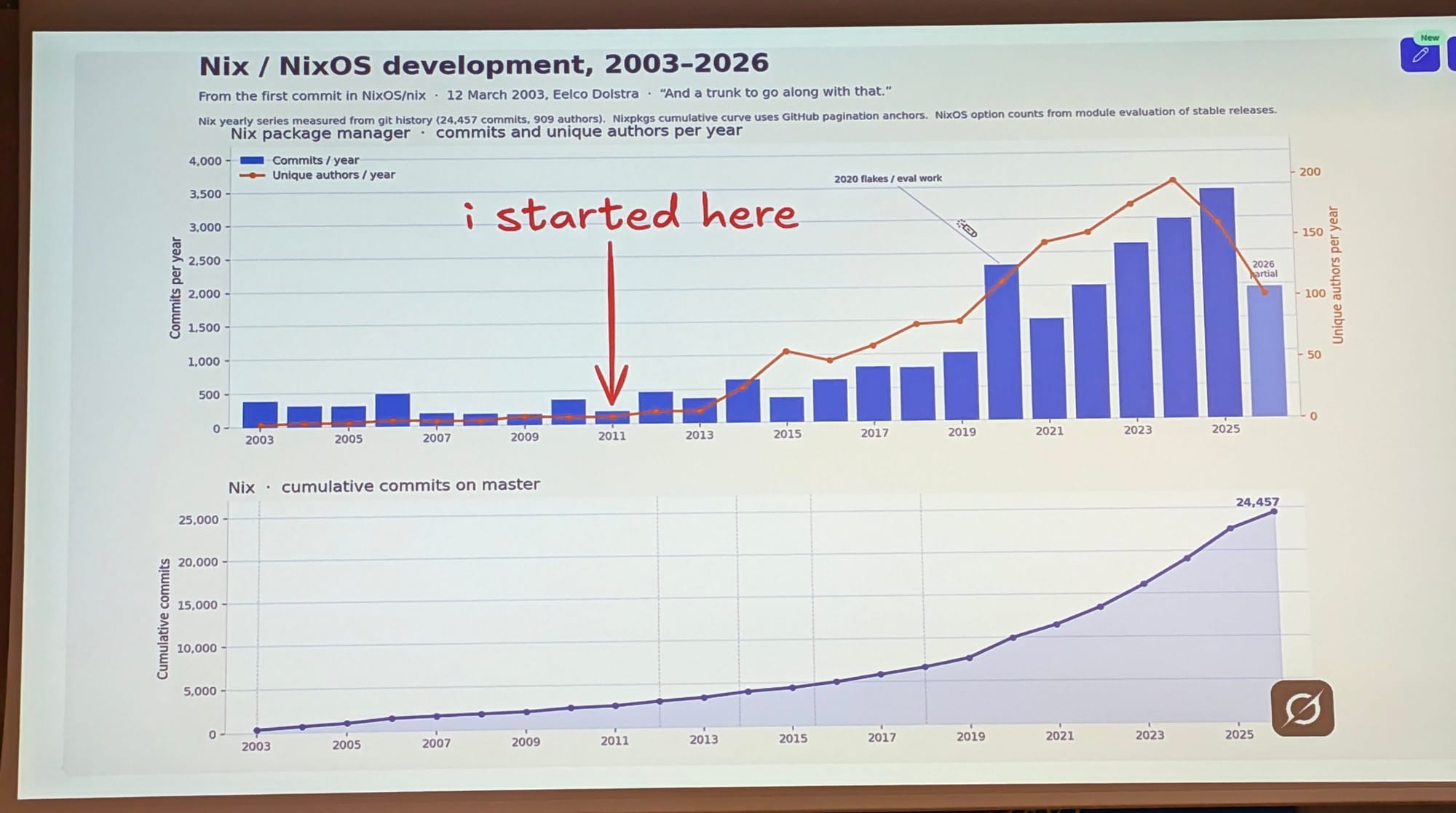
He wants to see it grow, and the talk covers the different ways he's attempting to do that.
Essentially he wants to make the audience that can use Nix much larger. Mainstream Nix is how to get Nix to a point where people could use it without knowing it's even there.
He considers Valve a big player in pushing Linux acceptance forward, but even then, that's 5% market share. So he's looking at running Nix natively on Windows. There are already several attempts and forks. He is excited that tvix, the Rust reimplementation of Nix, will help move this forward.
Right now with vanilla Nix you can do binary installs, but there's no native building. You need to cross compile. He put together a Windows equivalent to patchelf called fixPath.
Nixing AI
Ron was tired and losing his voice. Disclosed his bias from working at Flox. More and more of his customers are AI companies. He promised not to mention his company again.
"nixing - verb, to use nix to solve all of our problems." (Not "nix" like "to get rid of"). He is seeing Nix quietly become a foundation layer for several labs.
His take is the state of AI infra is pretty fragile. The frontier model labs were really focused on better models, and not as much on the other pieces of infra.
AI needs better reproducibility, which is hard with non-deterministic inference stacks. So companies use containers, but those are only reproducible at the image level.
His points:
- Promote declarative environments rather than images.
- Wants to be able to reproduce the local AI stack.
- Gives agents a fixed runtime contract.
Nix can help you do all of that right now. They are trying to improve it by creating a standard mkAgentStack.
Lightning talk - NixOS on RISC V
This was a 5 minute talk. liberodark is doing the good work of getting NixOS up on RISC V. He's been testing on the SpaceiT K1, then the K3. He chose the boards because they are RVA23 which is the profile the RISC V ecosystem now targets.
His view is that a fix merged in nixpkgs unblocks every package that depends on it. You can think of it as a form of leverage. So he's making lots of PRs.
His end goal is to make 26.05 and 26.11 usable on RISC V and add nixos-hardware support.
Talks I missed
There were too many talks I wanted to see. Thankfully, recordings should go up at some point. The ones I want to watch are:
- finix
- nix panel
- Nixception: Uncompromising incremental builds inside the sandbox… and outside!
- NixOS in the Corporate Trenches: Cuts and Bruises
The last one in particular will be useful when I return to work and present about the conference.
No spam, no sharing to third party. Only you and me.

Member discussion