It's Ploopin' Time
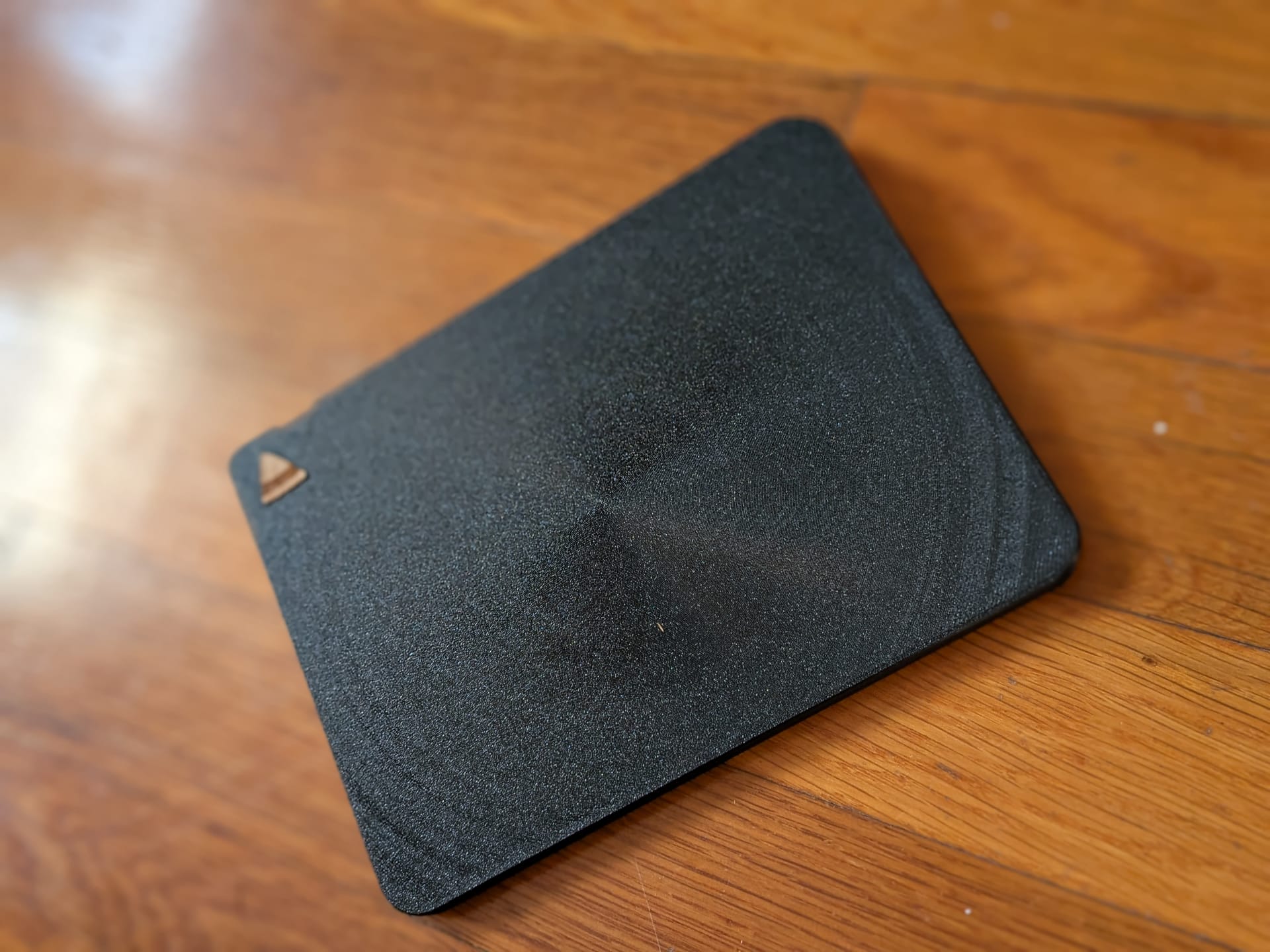
Despite the fact that I frequently write about trying to purchase and own less things... I do continue to purchase and own more things. This time I bought the the Ploopy Touch when a friend cursed me with the knowledge messaged me to let me know it exists.
Ploopy what? Ploopy Touch what?
Ploopy is a Canadian company that makes open hardware that describes themselves as "radically open-source". I love that.
I talk a lot about open software, see my post on GrapheneOS. I haven't talked much about open hardware though. The closest post is about the Framework 13 laptop, but those are not truly open. In I never thought I could be a maker I covered how I want to better understand how hardware is made. Buying a Ploopy product feels like both a great way to support a company in that space and also an opportunity for me to learn.
I believe the Touch is the fourth category of products that Ploopy has released. The first three were a mouse, a trackball, and headphones. Their trackpad was followed by a knob they describe as something "you’ll want to touch all day long". I've wanted to buy the mouse in the past, ever since a friend grabbed one. However, I have several mice that have not yet kicked the bucket so I can't justify getting a new one. I have a magic trackpad I use at work [1], but no trackpad at home yet. So trackpad it was.
Thankfully, Ploopy has resumed US shipping. Since the products are designed and manufactured in Canada, they fall under Canada-United States-Mexico Agreement (CUSMA) and are exempt from tariffs:
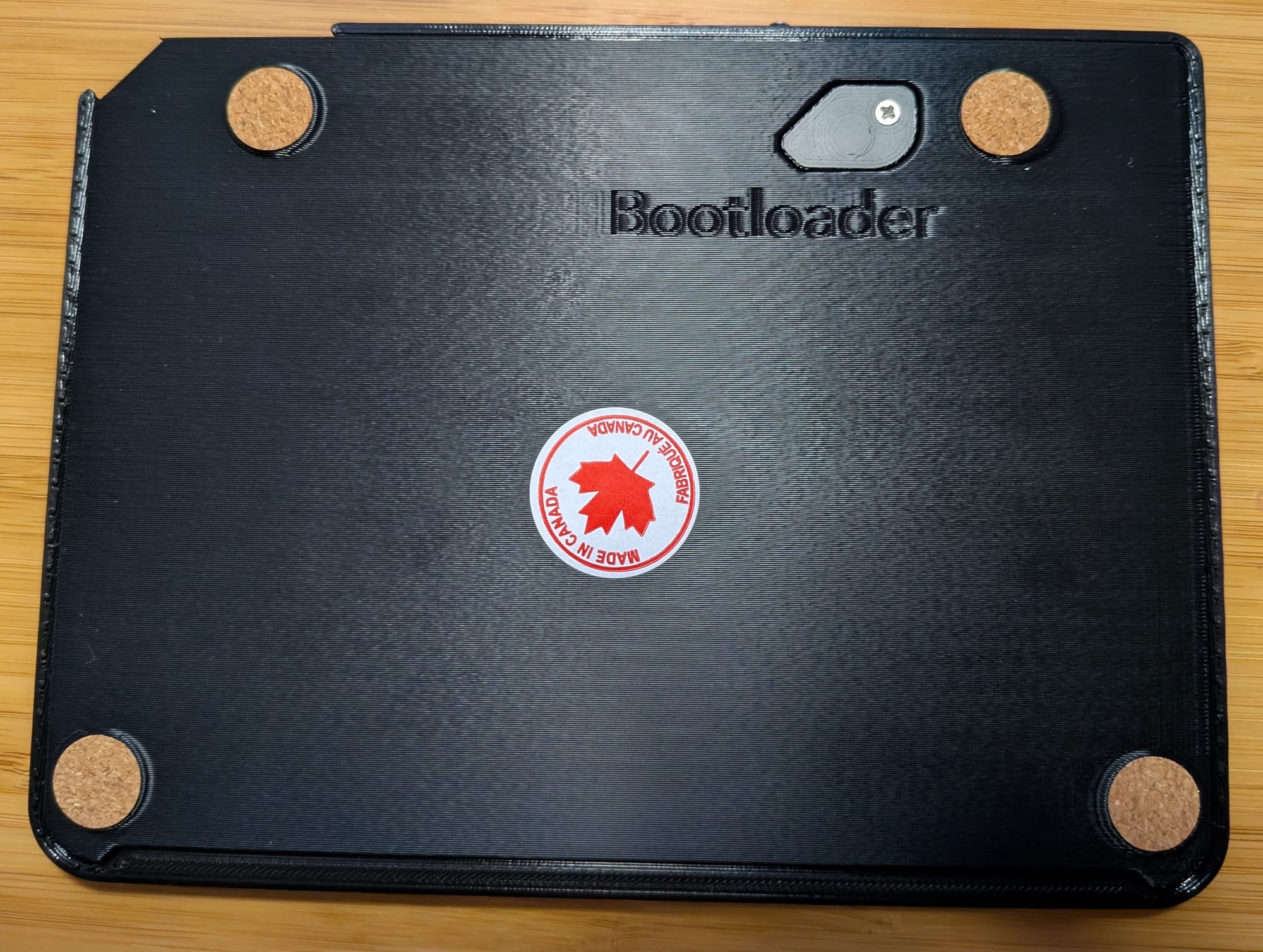
In order to demonstrate compliance with CUSMA, we need evidence directly on our products that they are indeed made in Canada. Every single product in a package needs to have a marker of its origin as Canada. Those of you based in the US will now see a dash of our Canadian pride in the form of these “Made in Canada” stickers.
The bad news
There is a DIY kit option and I purchased that one. All the instructions are on Github. However, I was accidentally sent a fully assembled kit. Oh the horror. This would be a boon for most people since the assembled version costs more, but I was hoping to document the assembly process to share here. Alas, I still opened the Touch up though to take a look.
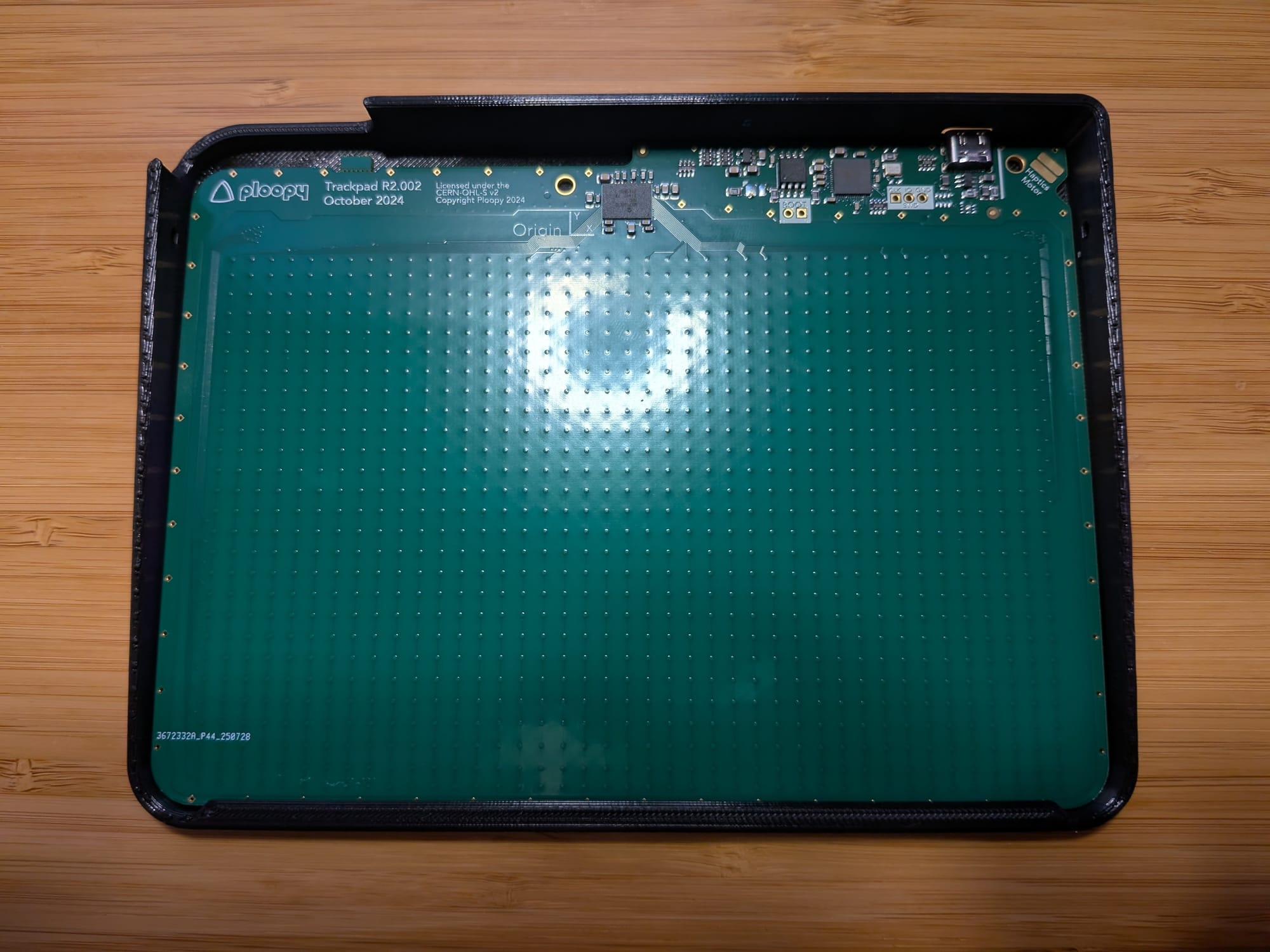
As far as assembly for me, I only had to do from step 8 onwards, which was... four screws [2] and then four friction pads.
The quality of the printer case was pretty good. There was one sharp point, but that was easy to sand down. The print certainly was better than I ended up with for my 3D printed case for my SmartSpin2k.
Also of note, the instructions said:
The Trackpad comes with a stylus. However, due to some technical limitations, the stylus is not enabled by default and therefore does not work. We expect to support stylus usage in the future.
In my post on the Framework 13's hardware I mentioned that Framework is not shipping haptic touch yet, but still wants to figure out how. Likewise this trackpad also does not have haptics. The Ploopy Knob seems to have some though, so maybe the company is experimenting with it now. I would love a non magic trackpad option for Linux with good feedback.
My first time seeing an open hardware license
All the hardware designs are in the repo. Yes, all the designs: the STL/STEP for the case, the parts library, the PCB designs and the schematic. Everything there is under the CERN-OHL-S-2.0 license, [3] which I had not heard about before. That makes sense given the license is designed for open-hardware and not FOSS.
I see there are three versions: S, W, and P for Strongly reciprocal, Weakly reciprocal, and Permissive. Ploopy is using the strong version of the license for their hardware. In this video from Week of Open Source Hardware (WOSH) 2019, Andrew Katz, who worked on the license, explains all the details nicely. Especially how FPGAs and ASICs have a lot of proprietary toolchains and they needed the license to work along side those.
A strong copyleft software license like GPL triggers on distribution of software. That doesn't make sense for hardware though. Instead copyright triggers when you make and distribute the products. This is a good defensive measure, since companies will try to wiggle out of copyleft licences. See my post on openTofu where I talk about FOSS products trying to relicense.
On the software side
As I mentioned in HackerBox 0121 - MCU Lab 2025, I've only ever bought assembled mechanical keyboards before. My first was the KBT Pure, which I destroyed by spilling soylent. Since then I've used a Vortex Pok3r that's been running strong since 2019. Both of these keyboards run a proprietary firmware made by their manufacturers. The Pure had some very basic key mapping and the Pok3r had some more substantive options, but everything was done through the keyboard.
At work I have a split keyboard called the ZSA Moonlander. The device runs an open firmware called the Quantum Mechanical Keyboard (QMK). The ErgoDox family of keyboards that the Moonlander comes from is directly supported by QMK thanks to contributions from ZSA. You can configure devices that run QMK through the QMK Configurator site, rather than directly through the keyboard.
The firmware is also a really flexible foundation to create your own keyboards. [4] The firmware also is flexible enough to make a touchpad. Ploopy has their own branch of QMK, while they work on getting upstreamed.
Now a touchpad doesn't require much configuration, so there is no need for the configurer site. In my case on NixOS with KDE simply plugging the Touch in and everything worked. All the KDE touchpad settings functioned as expected:
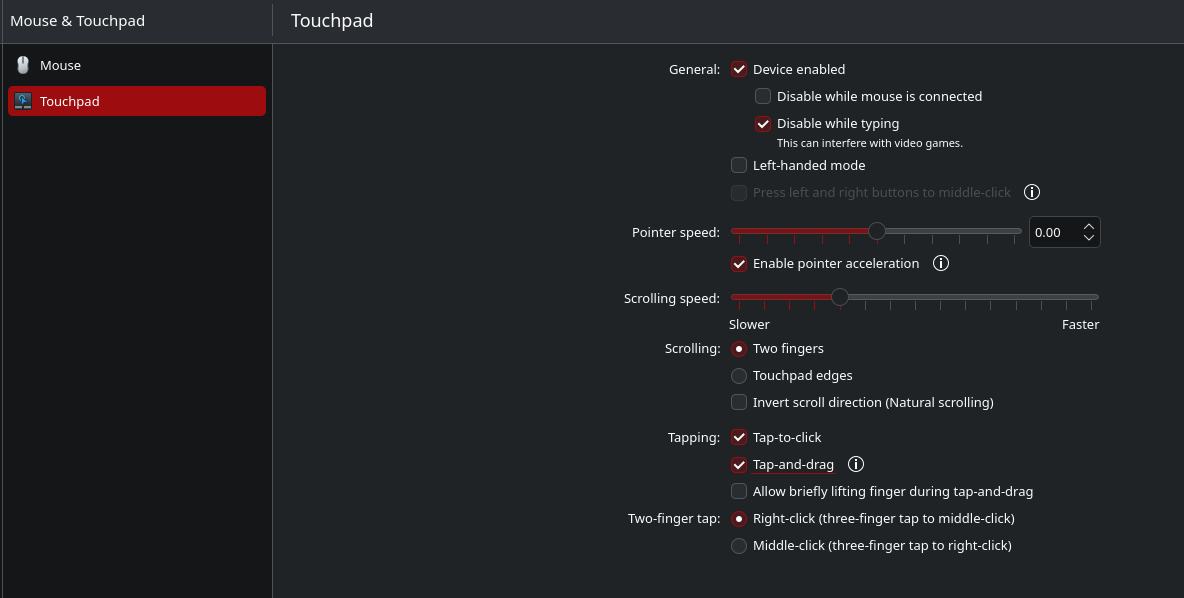
Even edge scrolling, which can be wonky sometimes, worked well.
Final thoughts, maybe future mods
Overall I like the Ploopy Touch a lot. The device does exactly what it says on the tin. Are there other things I would like? Of course, always. Thankfully Ploopy has a modder's guide and their mod index already shows a glass top project someone has done. Personally I would love a wireless version one day, just to make the cable management a little better. That would require fitting a battery and a bluetooth chip inside though. I already have way too many bluetooth projects on my plate right now. Maybe someday I'll revisit the idea, or if I'm lucky someone else will beat me to it. The upside of open hardware is we all benefit from others contributions.
Since we use Macbook Pros at work. Hey, I'll take that over Windows desktops like I had at my first job. ↩︎
Now, ironically the top screw wouldn't sink for me and started to strip. Luckily since this is open hardware I can order myself a new screw. ↩︎
Yes that CERN, of the particle accelerators. ↩︎
My friend is working on an attachable thumb keyboard for phones that uses another open firmware called ZMK. ZMK is more focused on wireless keyboards. ↩︎
Member discussion