Griffin McElroy On Writing His CYOA Book The Stowaway
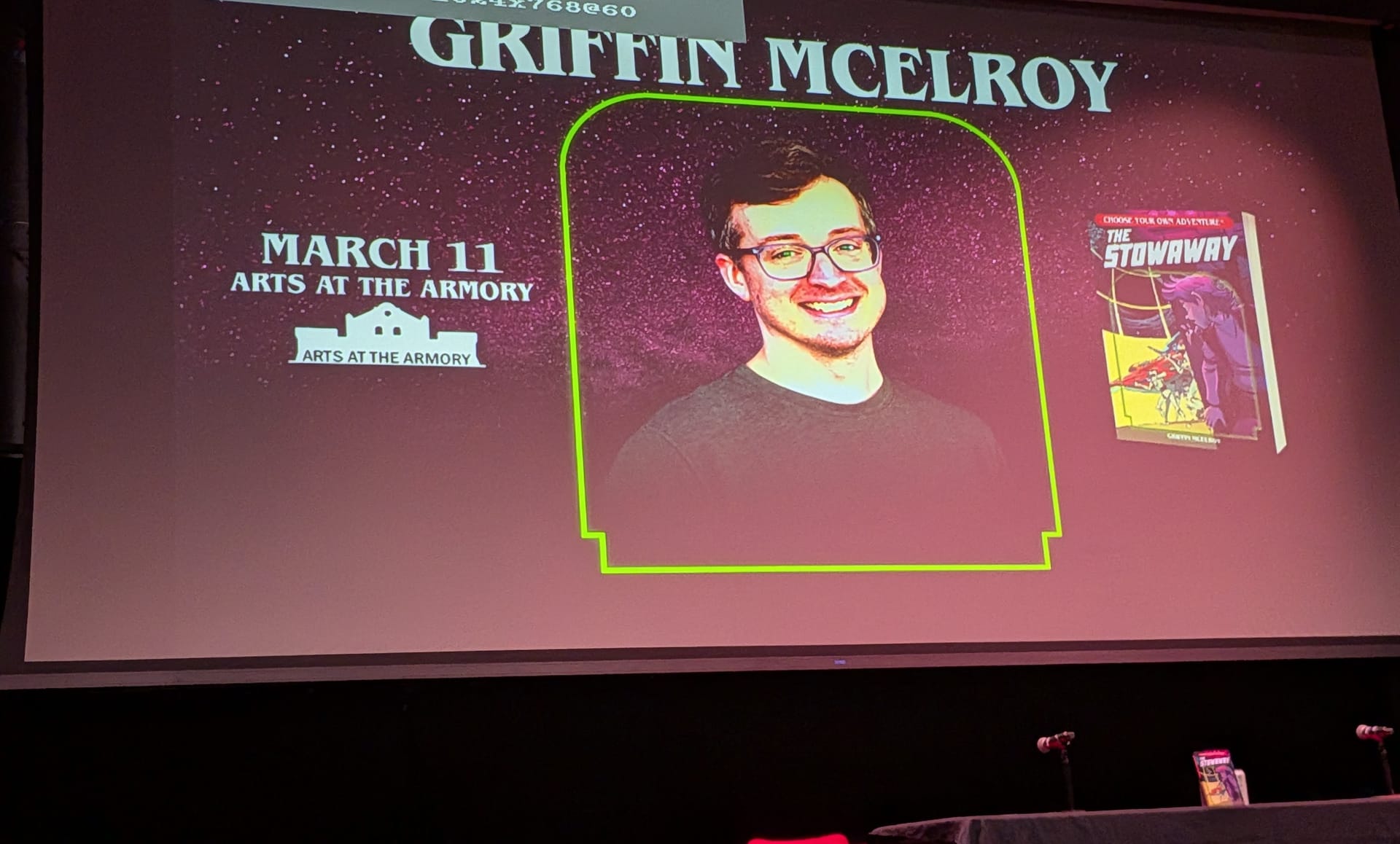
This post is a little different than usual. A friend reached out asking me to go an event at Arts At The Armory in Somerville. At that time the page had no description and only the title "Griffin McElroy", but that was enough for us to buy tickets. In my post on what podcasts I'm listening to there is a whole section on McElroy family podcasts.
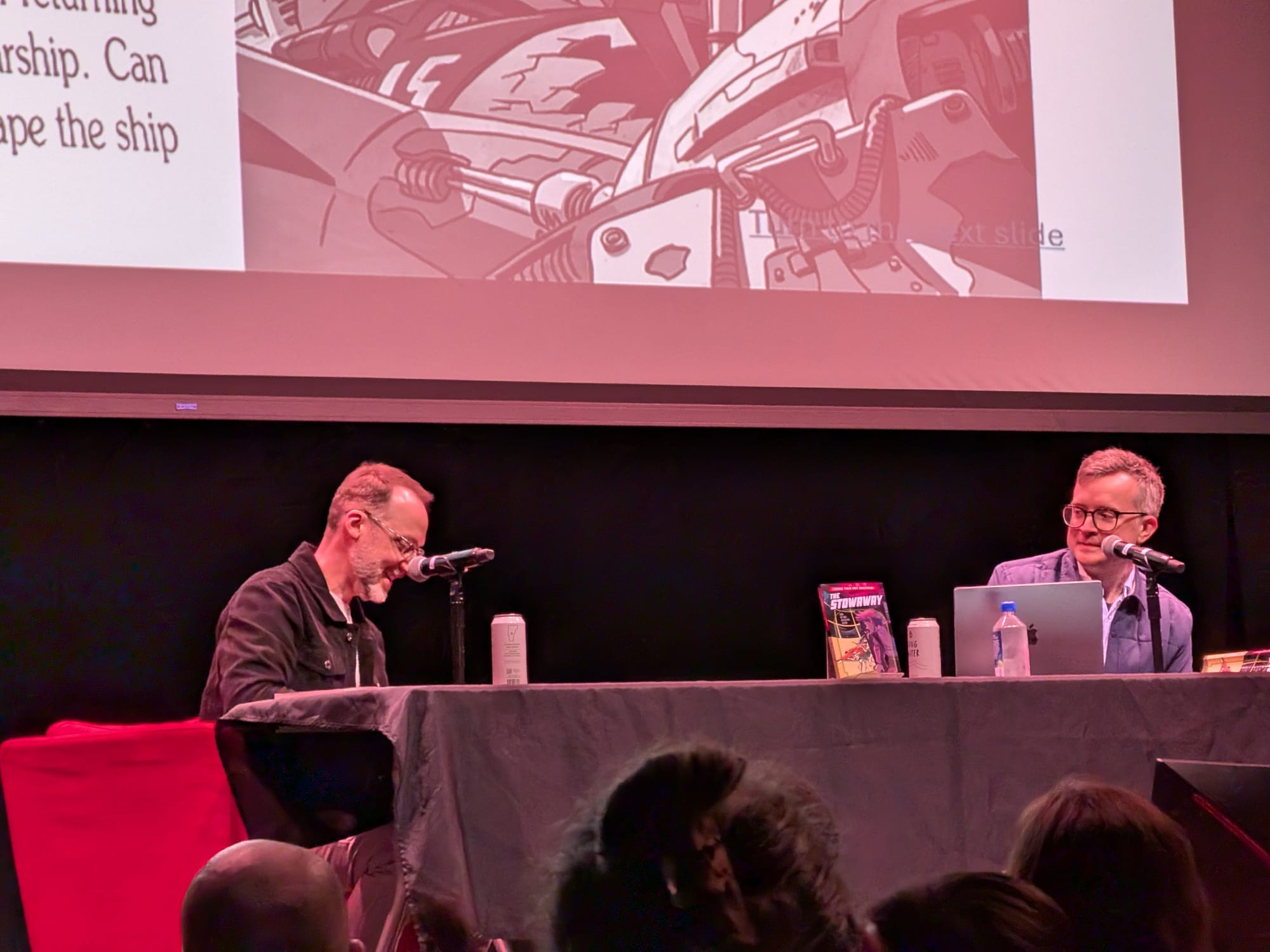
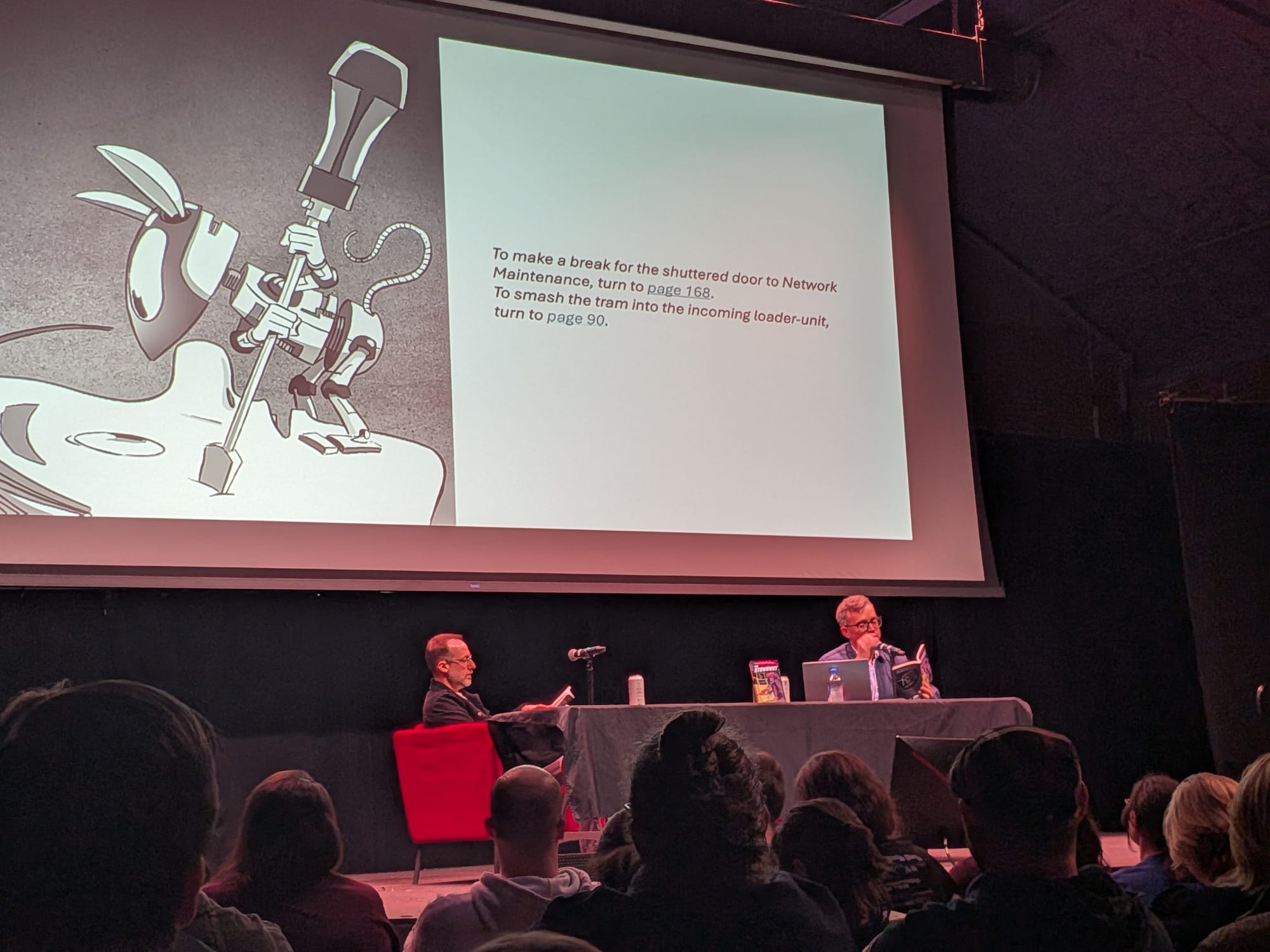
The event actually was a live reading from The Stowaway by Griffin, an interview by fellow author Aaron Mahnke, and audience Q&A. The ticket also including a copy of the book.
Weirdly enough, this was the only venue where Griffin talked about his new book. Luckily since I've been practicing writing I decided to take notes. I thought I'd share them since Griffin gave some really good advice and no one else will get to have this experience.
The interview
Aaron did a great job leading the interview portion with Griffin. The two had a great rapport. Also, the questions here are all reconstituted from my hastily written notes so they are not the exact questions, but pretty close.
Q: How did Griffin get into choose your own adventure books (CYOA)?
Griffin "was never a book guy as a kid", though his two brothers and dad were very much into reading. However he did play text heavy games like FF2 (FF4) at 5 years old.
His first real exposure to books was when his family would go on long road trips. His dad Clint would do two things every time:
- find an all you can eat crab leg restaurant and "single handedly decimate a crustacean population".
- find a used bookstore.
This was pre-google maps, but his dad just had friends that would know where to go. He would spend at least two hours there looking for books and Griffin would have to find a way to pass the time. Of course he had his Game Boy, but he discovered choose your own adventure books and started getting one or two on every trip.
In his mind CYOA were the most video game like book option out there.
The books he really remembers as a kid were the R.A. Montgomery books The Abominable Snowman and Space and Beyond. Space and Beyond was especially mind blowing because the very first choice involved picking between two different planets and that felt like there were two stories in one book. Of course the Goosebumps books were memorable too.
Q: What was it like making the book?
Griffin hadn't read a CYOA book for a while, but visual novels acted as a touchstone for him. He mentioned The Nonary Games as an example. Also, as a kid he played text parser games like Zork, Ultima, and Kings Quest.
"I didn't read a lot, but when I did it was on a screen and almost always localized from Japanese."
Chooseco was the one to reach out to Griffin, but he was on board from the start. Pedro Rodríguez did the art and when Chooseco sent it over to Griffin to see he knew it was a match.
Q: Do your kids enjoy CYOA books?
His oldest son Henry is 10 now, and Griffin thought he might be able to trick him into reading like his dad did to him. However, Henry got scared by a witch killing him the first book they tried. He hadn't wanted to try another book until the day before the show when he asked Griffin to. That might be because Henry heard there was a dedication to him at the start of the book.
Q: Was a CYOA book a good match for your writing style?
People often talk about how there are two types of writers: those who fly by the seat of their pants (pantsers) and those who carefully plan everything out (plotters). A CYOA is definitely a plotter's type of work.
Griffin and his dad did most of the writing on the book adaptations of The Adventure Zone. That informed how he wrote this book. Also, for the podcast Griffin will plan a lot out ahead of time, but when GMing in game for the podcast he adjusts things as needed. Whereas the book is entirely planning.
Q: What was the process like for writing the book?
The first thing Griffin had to do was figure out how all the pieces of the CYOA fit together. His editor Ben Wilgus suggested using draw.io to map out the flow of the book. Before that he had a pile of index cards on the floor "like the laziest person trying to solve a mystery". He was going to do a crime wall, but thought that if he put them on the floor "it's not like they would go anywhere".
It was really important to get the flow right because it would have been tough to make big structural changes after he started working. A change to an individual section impacts everything else so much. So once he figured out the flow, he could work on each part in isolation.
This was especially important because he said he has trouble staying on schedules. As a heavy planner this "was the format for him" and made it easier to hit his agreed on deadlines.
Q: What was it like adapting the Adventure Zone podcast as books?
Griffin mentioned that adapting an existing story is hard. To change a work is worse than to make something wholly new. Thankfully for Balance there were natural split points to make the seven books. The down side of course is that that also means essentially writing seven different stories. Griffin added: "I am medicated to do this".
Also, he mentioned he has a big e-ink tablet and that he only uses for scheduling. [1]
Q: Would you do it again?
"Yes!"
Though Griffin noted that for him and his family there is a little guilt any time they do something that is not the main podcasts because that is their "real" job. They sort of have to come to their fans with their hat in their hands. In general it can be tough to find a place for other projects w/ four podcasts a week.
Q: How did working on the Advanture Zone help you?
There was sort of a natural progression from the work plotting out seasons of the Adventure Zone. GMing ended up being great prep for writing this kind of book. However, he cautioned that writing a CYOA book would not be a good prep for GMing.
Q: Are there any endings that are you favorite?
There are 26 endings and yes he has a favorite, but you'll have to read to find it. He said it would be fairly obvious. Also, Ben Wilgus gave some advice: it is a mainstay of the genre to have some wild endings. Ones that even can feel tonally off and that should be honored.
The audience Q&A
After Aaron's interview there was a chance for some quick audience questions.
Q: I am also a writer. Does the feeling "what if no one cares?" ever go away?
"No. It truly doesn't. I didn't even know if anyone was going to come watch me read it tonight."
Q: What is an ending you were sad to cut?
Thankfully Griffin didn't have to totally cut any endings. He made a schedule so that he would not write more than he needed to. However, "there's a little cyberspace detour" that got a bit long when he realized he just wanted to do a REBOOT style story. So he had to can a lot of that down.
Q: As a multiformat story teller, what is the easiest way to get it all out?
"Motivation is not the word... I don't want to sound like a stick with it kind of guy". What actually helped him was having a contract with a timeline.
Griffins best advice: if you complete one story, don't think of the other 99 unfinished stories in the folder as a failure. Instead think "I wrote that. I made that. I got better from it." Everything is cumulative and if he doesn' think he will get excited enough to finish a story, it wasn't worth doing.
Q: Did you beta test the book?
Griffin knows some authors do that, he did not. Instead he had just a few rounds of edits. Also, some people think CYOA are just for kids so he wasn't sure about asking others. Though Griffin noted that they are the rare opportunity to read a second person story and even adults should try them.
Q: Why Somerville, MA for your one and only stop?
"There is no satisfactory answer". Griffin did not select the venue, but was so thankful that everyone came. His family has been to Boston a lot for other tours, but only the city proper. He said he was charmed by walking around Somerville and it reminded him of his time in Roscoe Village in Chicago.
These are mostly some raw notes right now. I'm taking a class on Writing and Publishing Politically Engaged Essays and I might use this to create my first op-ed style article. I'll post that if I use this material for my class.
Also, this show got me excited to read the book with my nieces and nephews. They are just about old enough now for a CYOA.
I am the same in that regard. ↩︎
Member discussion